Introduction
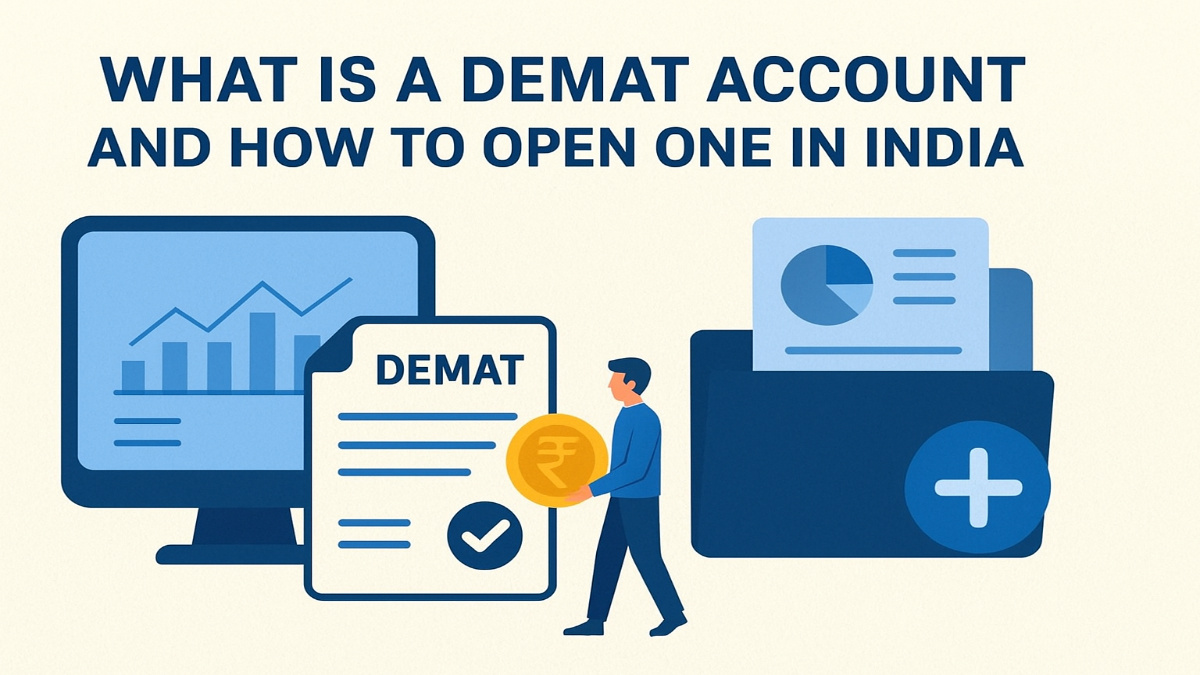
Investing in the Indian stock market has become one of the most popular ways to build wealth. But before you start buying shares of your favorite companies, there’s one thing you absolutely need: a Demat account. Whether you’re a complete beginner or someone who has just started exploring the world of finance, understanding a Demat account is your first step.
Think of it like this – just as you need a savings account to keep your money safe, you need a Demat account to hold your shares. Without it, investing in the stock market today is impossible. In this guide, we’ll walk you through everything – from what a Demat account is, why you need one, how to open it, charges involved, to the safety measures you must take. By the end, you’ll know exactly how to start your investment journey smoothly.”What Is a Demat Account and How to Open One in India”
Table of Contents
Understanding the Basics of a Demat Account
The word Demat stands for Dematerialization. It means converting physical share certificates into electronic form. Earlier, investors used to hold actual paper certificates whenever they bought shares, which was not only risky but also complicated. Imagine losing a certificate or having it stolen – it was a nightmare!
A Demat account solves this problem by storing shares digitally. You don’t have to worry about theft, forgery, or handling tons of papers. Everything is safe and accessible online.
But wait – don’t confuse a Demat account with a Trading account. Here’s the difference:
- Demat Account = Acts like a digital locker for your shares.
- Trading Account = Acts like a shop where you buy and sell shares.
Whenever you buy a share, it gets stored in your Demat account. Whenever you sell, it goes out of it. Together, they form the backbone of stock market investing.
Also read: Top 10 Tips for Achieving Financial Discipline and Long-Term Wealth
History and Evolution of Demat Accounts in India
Before 1996, investing in India was very different. People had to deal with physical share certificates. Transactions took weeks, and fraud was common. Duplicate certificates, fake signatures, delays in transfers – these were everyday problems.
In 1996, the National Securities Depository Limited (NSDL) introduced Demat accounts, revolutionizing the Indian stock market. Later, Central Depository Services Limited (CDSL) also came into the picture, giving investors more choices.
Here’s a quick timeline of how Demat accounts evolved in India:
- 1996: NSDL launched the first Demat account.
- 2000s: CDSL joined, making Demat accounts widely available.
- 2010s: Online brokers simplified account opening with paperless KYC.
- 2020s: Demat accounts became a must-have, with millions of new investors joining after the pandemic.
Why Do You Need a Demat Account?
Here are the main reasons why:
- Legal Requirement – SEBI (Securities and Exchange Board of India) has made it mandatory to use Demat for stock investments.
- Convenience – No physical papers, no risk of loss or damage. Just a few clicks and you’re done.
- Safety – Digital records are secure, verified, and backed by NSDL or CDSL.
- Faster Transactions – Earlier it took weeks to transfer shares. Now it takes just a day.
- Access to Multiple Investments – With one Demat account, you can hold stocks, bonds, ETFs, IPO shares, and even government securities.
Also read: Microsoft vs Apple Stock Which Is Better for Long-Term Investment?
Types of Demat Accounts in India
Not all Demat accounts are the same. Depending on your needs, you can choose from different types:
- Regular Demat Account
- Designed for Indian residents.
- Best for people who want to invest in stocks and bonds.
- Repatriable Demat Account
- For Non-Resident Indians (NRIs).
- Allows transfer of money abroad, but requires an NRE (Non-Resident External) bank account.
- Non-Repatriable Demat Account
- Also for NRIs, but money cannot be transferred outside India.
- Needs an NRO (Non-Resident Ordinary) bank account.
- Basic Services Demat Account (BSDA)
- Best for beginners or small investors.
- If your holdings are less than ₹2 lakhs, you pay lower charges.
How Does a Demat Account Work?
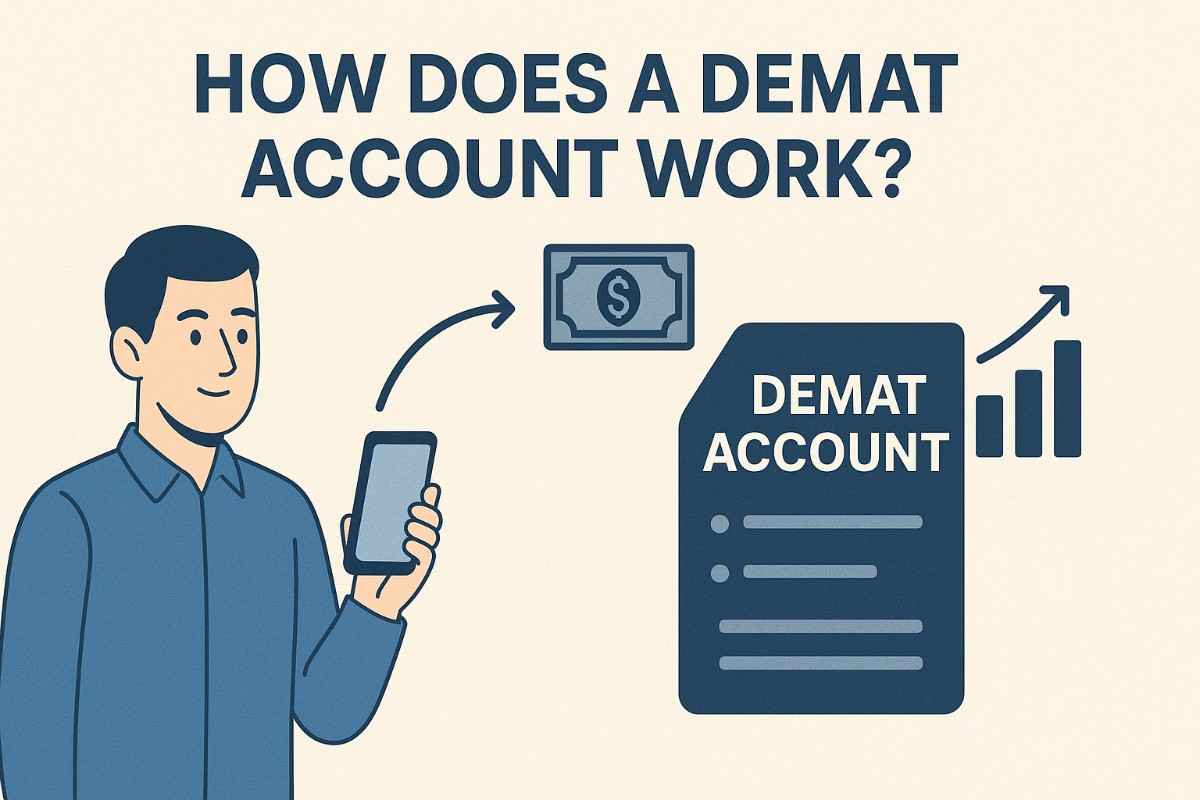
Think of a Demat account as a digital vault for your investments. Here’s how it works step by step:
- You open a Demat account with a Depository Participant (DP) (like Zerodha, ICICI Direct, HDFC Securities, etc.).
- When you buy shares through your trading account, they get credited to your Demat account.
- When you sell shares, they are debited from your Demat account.
- The NSDL or CDSL ensures the record is updated and secure.
- Your Demat account works along with your bank account and trading account, creating a smooth cycle of money in and shares out.
Step-by-Step Process to Open a Demat Account in India
Opening a Demat account today is much simpler than it was a decade ago. Thanks to online KYC and e-signature, you can do it within minutes from your smartphone. Let’s break it down step by step:
Step 1: Choose a Depository Participant (DP)
You must first select a broker, bank, or financial institution that offers Demat services. Popular choices include Zerodha, Upstox, ICICI Direct, HDFC Securities, Angel One, and others.
Step 2: Fill Out the Application Form
Once you choose a DP, visit their website or app to fill in your personal details such as name, date of birth, PAN card number, mobile number, and email ID.
Step 3: Submit KYC Documents
You’ll need to upload scanned copies of your documents (we’ll cover this in the next section). This usually includes PAN, Aadhaar, a canceled cheque, and a passport-sized photo.
Step 4: In-Person Verification (IPV)
To verify your identity, some brokers ask for a short video verification where you show your documents and face. Nowadays, most brokers have simplified this to online verification.
Step 5: E-Signature
After verification, you will be asked to sign the documents electronically using Aadhaar-linked OTP.
Step 6: Account Activation
Once everything is checked, your account will be activated within 24–48 hours. You’ll then receive your Demat Account Number (DP ID + Client ID).
👉 Pro Tip: If you are new, go for brokers with zero account opening charges and low Annual Maintenance Charges (AMC).
Eligibility Criteria to Open a Demat Account
- Age Requirement
- There is no minimum age to open a Demat account. Even minors can have one, but it must be operated by their guardian until they turn 18.
- Residency Status
- Both Indian residents and NRIs (Non-Resident Indians) can open Demat accounts.
- NRIs, however, need to open Repatriable or Non-Repatriable Demat accounts depending on whether they want to move funds abroad.
- Mandatory Documents
- You must have a PAN card (compulsory as per SEBI regulations).
- Aadhaar card and bank details are also required.
- Multiple Accounts Allowed
- A person can open multiple Demat accounts with different brokers, but each account must be linked to their PAN card.
Documents Required for Opening a Demat Account
Opening a Demat account requires basic KYC (Know Your Customer) compliance. Here’s the complete checklist of documents you’ll need:
1. Identity Proof (Any one of these):
- PAN Card (mandatory)
- Aadhaar Card
- Passport
- Voter ID
- Driving License
2. Address Proof (Any one of these):
- Aadhaar Card
- Passport
- Voter ID
- Utility Bills (Electricity, Water, Gas – not older than 3 months)
- Bank Statement/Passbook
3. Bank Account Proof:
- Cancelled cheque
- Recent bank statement with IFSC code
- Passbook copy
4. Income Proof (Only required for derivative trading like Futures & Options):
- Latest Salary Slip
- Income Tax Return (ITR)
- Form-16
- 6-month Bank Statement
5. Photograph & Signature:
- Recent passport-size photo
- Scanned signature (for e-signing forms)
Charges and Fees for a Demat Account
While opening a Demat account may be free with some brokers, maintaining it isn’t always free. Here are the typical charges:
- Account Opening Charges (One-time):
- Some brokers charge ₹200–₹500.
- Many discount brokers like Zerodha and Upstox offer free account opening.
- Annual Maintenance Charges (AMC):
- This is the yearly fee for maintaining your Demat account.
- Ranges between ₹200–₹800 per year.
- Some brokers waive AMC for the first year.
- Transaction Charges:
- Every time you buy or sell shares, a small fee is charged (₹15–₹25 per transaction).
- Custodian Fee:
- Charged by depositories (NSDL/CDSL) for safeguarding your securities.
- Usually covered by your broker, so you may not see it separately.
- Hidden Charges:
- SMS charges, dematerialization/rematerialization charges (converting physical shares to digital and vice versa).
- Debit transaction charges when you sell shares.
Also read: Top 5 Indian Stocks for Long-Term Investment in 2025
Top Depository Participants (DPs) in India
When you open a Demat account, you don’t deal directly with NSDL or CDSL (the two depositories in India). Instead, you go through an authorized agent called a Depository Participant (DP). These can be banks, stockbrokers, or financial institutions.
Some of the top DPs in India include:
1. Banks Offering Demat Accounts
- HDFC Bank – Provides integrated savings + trading + Demat services.
- ICICI Bank – Popular for 3-in-1 accounts (bank + trading + Demat).
- Axis Bank – Good customer support and user-friendly services.
- Kotak Mahindra Bank – Known for premium Demat account facilities.
2. Full-Service Brokers
- ICICI Direct – Provides research reports, advisory, and portfolio management.
- HDFC Securities – Offers wide product range like bonds, ETFs, IPOs.
- Kotak Securities – Personal advisory for large investors.
3. Discount Brokers
- Zerodha – India’s largest discount broker, famous for low-cost trading.
- Upstox – Backed by Ratan Tata, offers affordable Demat accounts.
- Angel One – Combines discount pricing with advisory features.
- Groww – New-age app-based broker, easy for beginners.
👉 Comparison Tip:
- If you want research and advisory → Choose full-service brokers.
- If you want low charges and self-managed investing → Choose discount brokers.
This choice depends on your investment style. Beginners often start with discount brokers, while long-term investors sometimes prefer banks or full-service brokers for safety and guidance.
Also read: What Is SIP (Systematic Investment Plan)?
Advantages of Having a Demat Account
Why should you open a Demat account? Let’s explore the biggest advantages that make it a must-have for investors in India:
1. Safety of Investments
Gone are the days when investors worried about losing physical share certificates. With Demat, everything is digital, secured by NSDL and CDSL.
2. Convenience and Accessibility
With just a smartphone, you can view, buy, or sell your holdings anytime. No paperwork, no waiting for couriered certificates.
3. Easy Transfer of Shares
Demat makes transferring shares between accounts smooth and quick. Earlier, it used to take 15–30 days; now, it’s just 1–2 days.
4. Nomination Facility
You can nominate a family member to inherit your holdings in case of unforeseen events. This makes succession planning easy.
5. Access to Multiple Assets
Not just shares – you can also hold bonds, ETFs, government securities, and mutual funds in a single Demat account.
6. Cost Savings
Although there are AMC and transaction charges, Demat reduces stamp duty and physical handling costs. Over time, this saves investors money.
Disadvantages of Demat Accounts
While Demat accounts bring many benefits, it’s important to know the downsides too:
1. Annual Charges
Every Demat account comes with AMC (Annual Maintenance Charges). Even if you don’t use the account, you still have to pay.
2. Hidden Charges
Some brokers add small charges like SMS alerts, debit transaction fees, or custodian charges. These may look small but add up over time.
3. Over-Trading Risk
Since investing has become so easy, beginners sometimes buy and sell frequently without proper research. This leads to unnecessary losses.
4. Technical Issues
Online platforms sometimes face outages or delays in updating holdings. If this happens during volatile market hours, investors may suffer losses.
5. Risk of Misuse
If you share your login details or fall for phishing scams, fraudsters can misuse your Demat account.
How to Use a Demat Account Effectively
Simply opening a Demat account is not enough – you must learn to use it wisely. Here are some pro tips to manage your Demat account like a pro:
1. Link All Accounts Properly
Always ensure your bank account, trading account, and Demat account are correctly linked. This avoids delays in fund transfers and share settlements.
2. Keep Your Documents Updated
If you change your mobile number, email, or address, update it with your DP immediately. Outdated contact details can cause communication problems.
3. Monitor Your Account Regularly
Log in at least once a week to check for:
- Unauthorized transactions
- Pending shares
- Dividend credits
4. Avoid Multiple Unused Accounts
Many beginners open accounts with several brokers but end up paying multiple AMCs unnecessarily. Close unused accounts to save costs.
5. Long-Term Perspective
Don’t just use Demat for short-term trading. Use it for building wealth through long-term investments like blue-chip stocks, ETFs, and bonds.
Taxation Rules on Demat Holdings in India
Investing through a Demat account also comes with taxation rules. Understanding them can help you save money legally.
1. Short-Term Capital Gains (STCG)
- If you sell shares within 12 months of buying, profits are taxed at 15% flat.
- Example: Buy at ₹100, sell at ₹150 in 6 months → ₹50 profit → 15% tax.
2. Long-Term Capital Gains (LTCG)
- If you sell shares after 12 months, profits up to ₹1 lakh per year are tax-free.
- Above ₹1 lakh, tax is 10% without indexation.
- Example: Profit of ₹1.5 lakh → ₹50,000 taxed at 10% = ₹5,000.
3. Dividend Taxation
- Earlier, dividends were tax-free.
- Now, dividends are added to your income and taxed as per your income tax slab.
4. Set-Off Rules
- If you make a loss in stocks, you can use it to reduce your taxable profits in the same year or carry it forward for the next 8 years.
👉 Keep records of all your transactions – your broker usually provides an annual statement that makes filing taxes easier.
Yearly Breakdown Table: Demat Account Growth in India (12-Month View)
The popularity of Demat accounts in India has been rising rapidly, especially after the pandemic when millions of new investors entered the stock market. To understand this growth, let’s look at a 12-month sample data table (illustrative) that shows how Demat accounts have been growing in India year by year.
Also read: Best Investment Options for Salaried Employees
Table: Growth of Demat Accounts (Sample Year – 2024)
| Month | New Demat Accounts Opened (in lakhs) | Total Demat Accounts (in crores) |
|---|---|---|
| January | 22 | 11.2 |
| February | 18 | 11.4 |
| March | 25 | 11.65 |
| April | 20 | 11.85 |
| May | 24 | 12.1 |
| June | 19 | 12.29 |
| July | 23 | 12.52 |
| August | 21 | 12.73 |
| September | 20 | 12.93 |
| October | 22 | 13.15 |
| November | 18 | 13.33 |
| December | 25 | 13.58 |
Safety Measures for Demat Account Holders
Just like your bank account, a Demat account also holds valuable assets. So, protecting it is extremely important. Here are some key safety measures:
1. Use Strong Passwords
- Never use simple passwords like your name, date of birth, or phone number.
- Use a mix of alphabets, numbers, and special characters.
- Change your password every 3–6 months.
2. Enable 2FA (Two-Factor Authentication)
Most brokers now offer OTP or authenticator app logins. Always enable this feature.
3. Watch Out for Phishing Scams
- Fraudsters often send fake emails or SMS with links.
- Always log in directly through your broker’s app or website.
- Never share your login ID, password, or OTP with anyone.
4. Regular Account Monitoring
Check your holdings and transaction statements frequently. If you notice any unknown debit, report it immediately to your broker.
5. Keep Mobile and Email Updated
All transaction alerts are sent to your registered email and mobile. Make sure these are always updated.
Tips to Choose the Best Demat Account for You
With so many brokers and banks offering Demat accounts, how do you pick the best one? Here are some practical tips:
1. Compare Charges
Look at account opening fees, AMC, transaction charges, and hidden costs. Choose the one that matches your investment style.
2. Check the Broker’s Technology
A fast, reliable mobile app and website are essential. Delays during trading hours can be costly.
3. Look for Good Customer Support
If you face issues, quick support can make a huge difference. Check reviews before choosing a broker.
4. Research Tools and Reports
If you’re a beginner, full-service brokers that provide research and advice may be better. If you’re confident, go with discount brokers for low costs.
5. Additional Benefits
Some brokers offer free AMC for the first year, free IPO applications, or educational webinars. These extras can be helpful.
FAQs
What is the minimum balance required for a Demat account?
There is no minimum balance requirement. You can open and maintain a Demat account even with zero holdings.
Can I have multiple Demat accounts?
Yes, you can open multiple Demat accounts with different brokers, but each must be linked to your PAN card.
How long does it take to open a Demat account?
With online KYC, most brokers activate your account within 24–48 hours.
Is a Demat account free?
Many brokers offer free account opening, but you still need to pay Annual Maintenance Charges (AMC) and transaction fees.
Can NRIs open a Demat account in India?
Yes, NRIs can open Repatriable or Non-Repatriable Demat accounts, depending on whether they want to transfer money abroad.
Disclaimer: Moneyjack.in provides general financial information for educational purposes only. We are not financial advisors. Content is not personalized advice. Consult a qualified professional before making financial decisions. We are not liable for any losses or damages arising from the use of our content. Always conduct your own research.