Gold has been a cornerstone of wealth in India for centuries, cherished not only for its cultural and emotional significance but also as a reliable investment during economic uncertainties. From glittering jewelry to gold coins bought during festive seasons like Diwali, gold holds a special place in Indian households. However, the traditional way of investing in physical gold comes with challenges like storage, purity concerns, and high costs. Enter Gold Exchange-Traded Funds (ETFs), a modern and convenient way to invest in gold without physically owning it.
But what exactly are Gold ETFs, and should you buy them? In this detailed guide, we’ll explore everything you need to know about Gold ETFs in India, their benefits, risks, how they compare to physical gold, and whether they’re the right investment for you.”What Are Gold ETFs and Should You Buy Them”
Table of Contents
What Are Gold ETFs?
A Gold ETF is an investment fund that tracks the price of gold and is traded on stock exchanges like the National Stock Exchange (NSE) and Bombay Stock Exchange (BSE) in India. Each unit of a Gold ETF typically represents one gram of physical gold with 99.5% purity, securely stored by the fund manager in insured vaults. Unlike physical gold, which you might keep in a locker or safe, Gold ETFs exist in electronic form, held in a demat account, and can be bought or sold just like stocks.
How Do Gold ETFs Work?
Gold ETFs function similarly to mutual funds but are specifically designed to mirror the price of gold. When you invest in a Gold ETF, your money is pooled with other investors’ funds to purchase gold bullion, which is stored by a custodian. The value of your investment fluctuates with the market price of gold. For example, if gold prices rise by 2%, the value of your Gold ETF units is likely to increase by a similar percentage, minus a small management fee known as the expense ratio.
Gold ETFs are listed on stock exchanges, allowing you to buy and sell units during market hours through a demat and trading account. When you redeem your Gold ETF units, you receive the cash equivalent based on the current gold price, not physical gold. This structure makes Gold ETFs a hassle-free way to invest in gold, especially for those who want to avoid the logistics of handling physical assets.
Types of Gold ETFs in India
In India, there are two main types of Gold ETFs:
- Direct Gold ETFs: These directly track the price of physical gold and are backed by gold bullion stored by the fund house.
- Gold ETF Fund of Funds (FoFs): These invest in other Gold ETFs rather than holding physical gold directly. They don’t require a demat account, making them accessible to investors who prefer mutual fund-like structures.
Benefits of Investing in Gold ETFs
Gold ETFs have gained popularity in India due to their numerous advantages over traditional gold investments. Here are the key benefits:
1. High Liquidity
Gold ETFs are traded on stock exchanges, making them highly liquid. You can buy or sell units during market hours at real-time prices, unlike physical gold, which may require finding a buyer or visiting a jeweler, often leading to delays and price negotiations.
2. Cost-Effectiveness
Investing in physical gold involves additional costs like making charges for jewelry (which can be 10-20% of the gold’s value), storage fees, and insurance. Gold ETFs eliminate these costs, as you don’t need to store or insure the gold yourself. Additionally, Gold ETFs have low expense ratios, typically ranging from 0.2% to 0.5% annually, making them a cost-efficient option.
3. Transparency
The price of Gold ETFs is directly linked to the market price of gold, ensuring transparency. Fund houses regularly disclose their holdings, so you know exactly what you’re investing in. Real-time pricing allows you to track your investment’s value easily.
4. Security
With Gold ETFs, you don’t have to worry about the safety of your gold. The physical gold backing the ETF is stored in secure, insured vaults by reputable custodians, eliminating risks like theft or loss associated with physical gold.
5. Tax Efficiency
Gold ETFs offer tax advantages. As of April 1, 2025, long-term capital gains (LTCG) on Gold ETFs held for more than 12 months are taxed at a flat rate of 12.5% without indexation benefits. Short-term capital gains (STCG) for holdings of 12 months or less are taxed at your applicable income tax slab rate. Additionally, there are no wealth tax, security transaction tax, VAT, or sales tax on Gold ETFs, unlike physical gold, which incurs GST and other charges.
6. Accessibility
You can start investing in Gold ETFs with as little as one unit, equivalent to one gram of gold, making them accessible to small investors. This contrasts with physical gold, which often requires a larger lump-sum investment.
How to Invest in Gold ETFs in India

Investing in Gold ETFs is straightforward and can be done in a few simple steps:
- Open a Demat Account: A demat account is necessary to hold Gold ETF units, similar to how you hold shares. Many brokers, such as Zerodha, Upstox, or Angel One, offer demat account services.
- Open a Trading Account: You’ll need a trading account linked to your demat account to buy and sell Gold ETF units through a broker.
- Research and Choose a Gold ETF: Evaluate Gold ETFs based on factors like assets under management (AUM), expense ratio, and past performance. Popular options include Nippon India ETF Gold BeES, SBI Gold ETF, and ICICI Prudential Gold ETF.
- Place Your Order: Log into your trading account, search for the desired Gold ETF, and place a buy order. You can purchase as little as one unit, making it affordable for most investors.
- Monitor Your Investment: Track the performance of your Gold ETF through your trading platform or financial apps like Tickertape, which provide real-time data and analytics.
Top Gold ETFs in India
As of mid-2025, the Indian Gold ETF market has surpassed ₹60,000 crore in assets under management, reflecting their growing popularity. Below is a table of some of the top-performing Gold ETFs in India, based on market capitalization and one-year returns:
| Name | Market Cap (₹ Cr) | Close Price (₹) | 1-Year Return (%) |
|---|---|---|---|
| Nippon India ETF Gold BeES | 5,168.88 | 83.61 | 42.34 |
| SBI Gold ETF | 2,644.09 | 86.15 | 42.56 |
| Kotak Gold ETF | 1,984.14 | 84.28 | 42.53 |
| HDFC Gold Exchange Traded Fund | 1,906.09 | 86.28 | 42.28 |
| ICICI Prudential Gold ETF | 1,905.05 | 86.38 | 42.87 |
| UTI Gold Exchange Traded Fund | 651.54 | 84.70 | 42.47 |
| Aditya BSL Gold ETF | 353.23 | 88.79 | 42.70 |
| Axis Gold ETF | 319.17 | 84.19 | 42.04 |
Source: Tickertape – Best Gold ETFs in India (2025)
These ETFs are among the largest and most popular in India, offering strong returns and high liquidity. When choosing a Gold ETF, consider factors like expense ratio, tracking error, and AUM, as larger funds often have better liquidity and lower tracking errors.
Performance of Gold ETFs vs Physical Gold
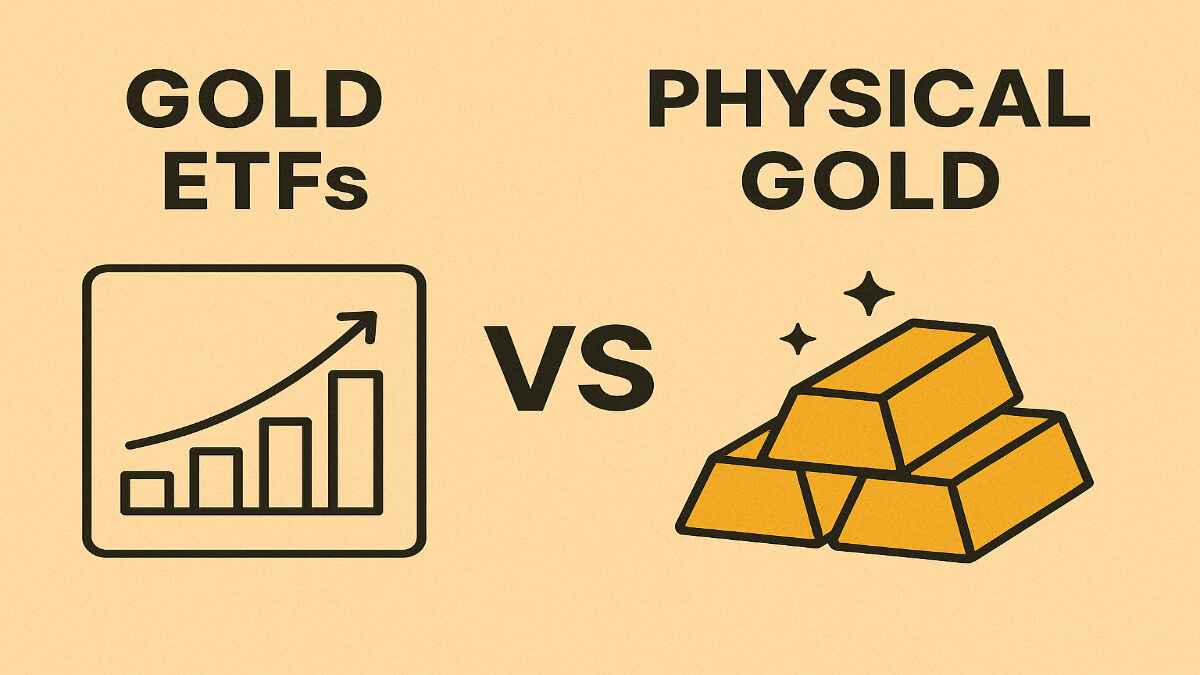
When deciding between Gold ETFs and physical gold, it’s essential to compare their performance, costs, and convenience.
Returns
Historically, physical gold has shown slightly better long-term returns due to the absence of management fees and tracking errors. From 2010 to 2025, physical gold prices rose from ₹18,500 to ₹88,996 per 10 grams, achieving a compound annual growth rate (CAGR) of 17.01%. Gold ETFs, while closely tracking gold prices, may have slightly lower returns due to expense ratios (0.2-0.5% annually) and tracking errors, which occur when the ETF’s performance deviates slightly from the gold price due to operational costs.
For example, in the fiscal year 2024-25, gold prices increased by 39.7%, while top Gold ETFs like ICICI Prudential Gold ETF delivered returns of around 28.11% from November 2023 to July 2025, indicating a slight underperformance due to fees (Source: Bajaj Finserv – Gold ETF vs Gold Mutual Fund).
Convenience
Gold ETFs offer superior convenience and liquidity. You can buy or sell units instantly on stock exchanges, whereas selling physical gold may involve visiting a jeweler, verifying purity, and negotiating prices. Physical gold also incurs additional costs like making charges (for jewelry) and GST, which can reduce net returns.
Taxation
As of April 1, 2025, the tax rules for Gold ETFs are:
- Short-Term Capital Gains (STCG): Gains from units held for 12 months or less are taxed at your applicable income tax slab rate.
- Long-Term Capital Gains (LTCG): Gains from units held for more than 12 months are taxed at a flat rate of 12.5% without indexation benefits.
In contrast, physical gold has a longer holding period for LTCG (24 months), also taxed at 12.5% without indexation as of July 23, 2024. However, physical gold purchases incur a 3% GST, which is non-refundable, whereas Gold ETFs are exempt from such taxes (Source: HDFC Sky – ETF Taxation in India 2025).
Should You Buy Gold ETFs?
Deciding whether to buy Gold ETFs depends on your investment goals, risk tolerance, and preferences. Here are some factors to consider:
When to Choose Gold ETFs
- Convenience and Liquidity: If you value ease of trading and don’t want to deal with storing physical gold, Gold ETFs are ideal. They allow you to invest in gold with just a few clicks.
- Portfolio Diversification: Gold is considered a safe-haven asset and a hedge against inflation. Including Gold ETFs in your portfolio can reduce overall risk by diversifying across asset classes.
- Small Investments: Gold ETFs allow you to start with as little as one gram of gold, making them accessible for investors with limited capital.
- Tax Efficiency for Short-Term Holdings: The 12-month holding period for LTCG makes Gold ETFs more tax-efficient for medium-term investors compared to physical gold (24 months).
When to Consider Alternatives
- Long-Term Investment: If you’re investing for the very long term (e.g., 10+ years), physical gold may offer slightly better returns due to the absence of management fees. However, you’ll need to account for storage and security costs.
- Tangible Assets: If you prefer owning physical gold for cultural or emotional reasons (e.g., for gifting or wearing as jewelry), physical gold might be more suitable.
- Sovereign Gold Bonds (SGBs): SGBs, issued by the Reserve Bank of India, offer a 2.5% annual interest rate and tax-exempt capital gains on redemption at maturity (8 years). They may be a better option for long-term investors seeking additional returns (Source: Tata Moneyfy – Income Tax on Gold).
Risks and Considerations
Investing in Gold ETFs comes with certain risks:
- Market Volatility: Gold prices can fluctuate due to global economic conditions, interest rates, and geopolitical events, impacting ETF returns.
- Expense Ratios: Management fees, though low, can reduce net returns over time.
- Tracking Error: The ETF’s performance may not perfectly match gold prices due to operational costs or inefficiencies.
- No Physical Ownership: You don’t own the actual gold, which may be a drawback for those who value tangible assets.
Comparing Gold ETFs with Other Gold Investment Options
To make an informed decision, let’s compare Gold ETFs with other popular gold investment options in India:
| Feature | Gold ETFs | Physical Gold | Sovereign Gold Bonds (SGBs) |
|---|---|---|---|
| Form | Electronic units in demat account | Jewelry, coins, bars | Government-backed bonds |
| Liquidity | High (traded on exchanges) | Moderate (requires buyer) | Low (8-year maturity, partial liquidity after 5 years) |
| Cost | Low expense ratio (0.2-0.5%) | Making charges, GST, storage costs | No additional costs, 2.5% interest |
| Taxation | STCG: Slab rate (≤12 months); LTCG: 12.5% (>12 months) | STCG: Slab rate (≤24 months); LTCG: 12.5% (>24 months) | Interest: Taxable; Capital gains: Exempt at maturity |
| Minimum Investment | 1 gram (₹80-100) | Varies (often higher) | 1 gram (₹80-100) |
| Storage | No storage needed | Requires secure storage | No storage needed |
Source: BusinessToday – Gold ETFs vs Physical Gold
FAQs
What is the minimum investment amount for Gold ETFs?
You can invest in as little as one unit, equivalent to one gram of gold, typically costing ₹80-100 depending on market prices.
How are Gold ETFs taxed in India?
Short-Term Capital Gains (≤12 months): Taxed at your applicable income tax slab rate.
Long-Term Capital Gains (>12 months): Taxed at 12.5% without indexation benefits.
Can I convert Gold ETFs to physical gold?
No, when you redeem Gold ETFs, you receive the cash equivalent based on the current gold price, not physical gold.
Are Gold ETFs safe?
Yes, the gold backing Gold ETFs is stored in secure, insured vaults by reputable custodians, reducing risks like theft or loss.
How do Gold ETFs compare to Sovereign Gold Bonds (SGBs)?
Gold ETFs offer high liquidity and no lock-in period, while SGBs provide a 2.5% annual interest rate and tax-exempt capital gains at maturity but have a longer lock-in period (5-8 years).
What is the expense ratio, and how does it affect returns?
The expense ratio is the annual fee charged by the fund house to manage the ETF, typically 0.2-0.5%. It reduces your net returns, so choosing an ETF with a low expense ratio is advisable.
Are Gold ETFs suitable for short-term trading?
Yes, their high liquidity makes them suitable for short-term trading, but be aware of STCG taxes and market volatility.
Conclusion
Gold ETFs offer a modern, convenient, and efficient way to invest in gold, making them an attractive option for Indian investors seeking exposure to gold without the hassles of physical ownership. Their benefits, including high liquidity, low costs, transparency, and security, make them a compelling choice for portfolio diversification and hedging against inflation. However, they come with risks like market volatility and expense ratios, and their returns may slightly lag behind physical gold due to management fees.
Whether you should buy Gold ETFs depends on your financial goals, investment horizon, and risk tolerance. If you value convenience and liquidity, Gold ETFs are an excellent choice. For long-term investors or those who prefer tangible assets, physical gold or Sovereign Gold Bonds may be worth considering. As with any investment, it’s wise to consult a financial advisor to ensure your decision aligns with your overall financial plan.
Disclaimer: Moneyjack.in provides general financial information for educational purposes only. We are not financial advisors. Content is not personalized advice. Consult a qualified professional before making financial decisions. We are not liable for any losses or damages arising from the use of our content. Always conduct your own research.