In today’s fast-paced world, buying a home, car, or even a smartphone often requires financial planning. For most people in India, taking a loan is a common way to afford big purchases without draining their savings. But with loans comes the term EMI—a word you’ve probably heard from bank executives, loan apps, or even friends discussing their finances. If you’re wondering, “What is EMI, and how is it calculated?” you’re in the right place. This article explains everything about EMI in simple English, tailored for Indian readers, with practical insights to help you make informed decisions.
Whether you’re planning to buy your dream home in Mumbai, a new car in Delhi, or the latest gadget in Bangalore, understanding EMI is crucial. Let’s dive into the details of EMI, how it works, and how you can calculate it to manage your finances better.”What Is EMI and How Is It Calculated? A Complete Guide for Indians”
Table of Contents
What Is EMI?
EMI stands for Equated Monthly Installment. It’s the fixed amount you pay every month to repay a loan within a specific period. This amount includes both the principal (the original loan amount) and the interest charged by the lender. In India, EMI is a popular term for anyone taking a home loan, car loan, personal loan, or even financing consumer goods like electronics.
Think of EMI as a way to break down a large loan into smaller, manageable monthly payments. Instead of paying the entire loan amount at once, you spread it over months or years, making it easier to budget. For example, if you take a ₹10 lakh home loan, your EMI will be a fixed monthly payment that covers both the loan amount and the interest over the loan tenure.
Why Is EMI Important in India?
In India, loans are a lifeline for many. From young professionals buying their first car to families investing in a home, EMI makes big purchases affordable. Here’s why EMI matters:
- Affordability: EMI allows you to buy expensive items without paying the full amount upfront.
- Budgeting: Fixed monthly payments help you plan your finances better.
- Flexibility: You can choose a loan tenure that suits your income, making EMIs manageable.
- Wide Usage: From home loans to credit card EMIs, this system is used across various financial products in India.
However, understanding how EMI is calculated is key to avoiding financial stress. Let’s explore that next.
How Is EMI Calculated?
Calculating EMI might sound complicated, but it’s based on a simple formula. Banks and financial institutions use this formula to determine your monthly payment. The EMI depends on three main factors:
- Loan Amount (Principal): The total amount you borrow.
- Interest Rate: The percentage charged by the lender on the loan amount.
- Loan Tenure: The time (in months or years) you take to repay the loan.
The EMI Formula
The mathematical formula for EMI is:
EMI = [P × R × (1+R)^N] / [(1+R)^N – 1]
Where:
- P = Principal loan amount
- R = Monthly interest rate (annual rate divided by 12)
- N = Number of monthly installments (loan tenure in months)
Let’s break it down with an example:
Suppose you take a ₹5,00,000 car loan at an 8% annual interest rate for 5 years (60 months).
- Principal (P) = ₹5,00,000
- Annual Interest Rate = 8%, so Monthly Interest Rate (R) = 8% ÷ 12 = 0.00667 (or 0.667%)
- Loan Tenure (N) = 5 years = 60 months
Plugging these into the formula:
EMI = [5,00,000 × 0.00667 × (1+0.00667)^60] / [(1+0.00667)^60 – 1]
This calculation is complex to do manually, but let’s simplify it. Using an EMI calculator (available on most bank websites or apps like Paytm or Bajaj Finance), the EMI for this loan comes to approximately ₹10,141 per month.
Factors Affecting EMI
Your EMI amount isn’t fixed across all loans. It varies based on:
- Loan Amount: Higher loans mean higher EMIs.
- Interest Rate: A higher rate increases your EMI or the total interest paid.
- Tenure: Longer tenures reduce monthly EMIs but increase the total interest paid.
For instance, if you extend the car loan tenure to 7 years instead of 5, your EMI might drop to around ₹8,000, but you’ll pay more interest over time.
Types of Loans with EMI in India
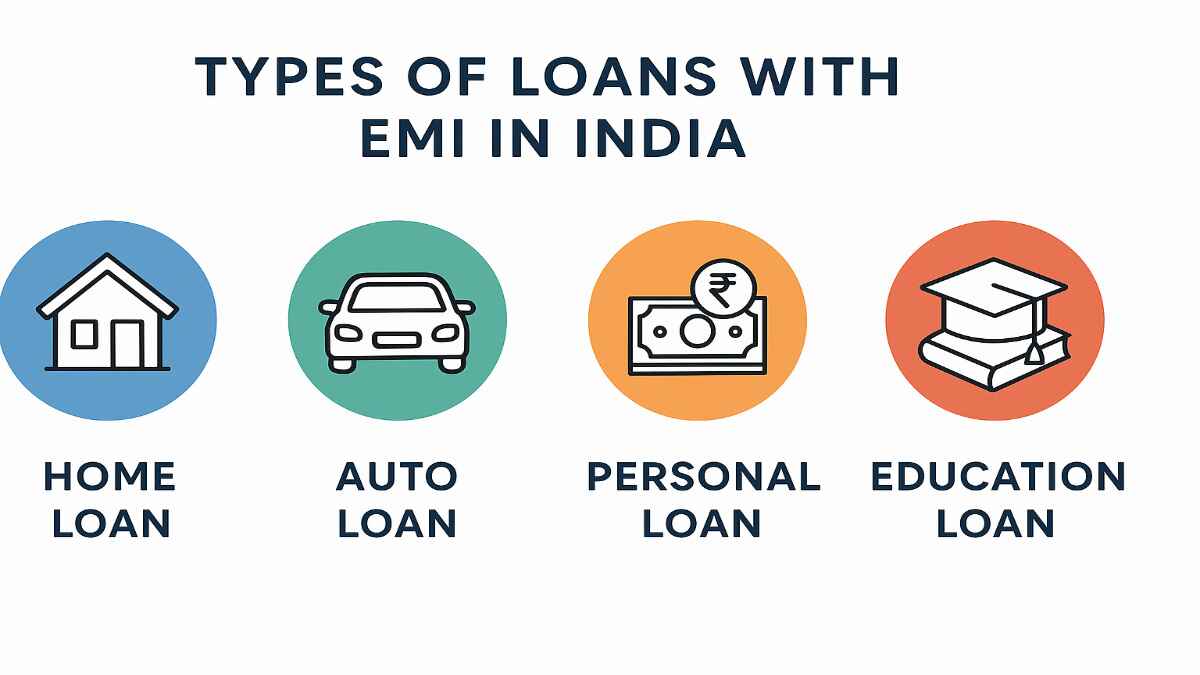
In India, EMIs apply to various loans. Here’s a look at the most common ones:
1. Home Loans
Home loans are the most popular in India, especially in cities like Pune, Chennai, and Hyderabad, where property prices are high. EMIs for home loans can stretch over 20–30 years, keeping monthly payments affordable. For example, a ₹50 lakh home loan at 7% interest for 20 years might have an EMI of around ₹38,765.
2. Car Loans
Car loans are common for middle-class families. With tenures of 3–7 years, EMIs make owning a Maruti Suzuki or Hyundai more achievable. A ₹7 lakh car loan at 9% interest for 5 years might cost around ₹14,900 monthly.
3. Personal Loans
Personal loans are unsecured, meaning no collateral is needed. They’re used for weddings, travel, or emergencies. EMIs for personal loans are higher due to higher interest rates (10–20%). A ₹2 lakh personal loan at 12% for 3 years could have an EMI of about ₹6,641.
4. Consumer Durable Loans
Want a new fridge or TV? Many retailers like Flipkart or Croma offer EMI options. These are short-term loans (6–24 months) with EMIs as low as ₹1,000–₹5,000, depending on the product cost.
5. Credit Card EMIs
Credit cards from banks like HDFC, SBI, or ICICI allow you to convert big purchases into EMIs. For example, buying a ₹50,000 phone on a 12-month EMI plan might cost ₹4,500 per month, including interest.
Benefits of EMI
Paying through EMI has several advantages, especially for Indian borrowers:
- Financial Discipline: Fixed monthly payments help you stick to a budget.
- Access to Big Purchases: You can buy a home or car without waiting years to save.
- Customizable Tenure: Choose a tenure that fits your income—shorter for less interest, longer for lower EMIs.
- No Need for Full Payment: EMI spreads the cost, making expensive items affordable.
However, EMIs also come with responsibilities. Missing payments can hurt your credit score and lead to penalties.
Things to Consider Before Opting for an EMI
Before signing up for a loan with EMI, keep these points in mind:
- Your Income: Ensure your EMI doesn’t exceed 40–50% of your monthly income. For example, if you earn ₹50,000 monthly, aim for EMIs below ₹20,000.
- Interest Rates: Compare rates from banks like SBI, HDFC, or NBFCs like Bajaj Finance. Even a 1% difference can save thousands.
- Loan Tenure: Longer tenures mean lower EMIs but higher total interest. Choose wisely based on your financial goals.
- Hidden Charges: Look out for processing fees, prepayment penalties, or late payment charges.
- Credit Score: A good CIBIL score (above 750) can get you lower interest rates, reducing your EMI.
Tools to Calculate EMI
Manually calculating EMI is tough, but you don’t have to. Here are some tools widely used in India:
- Bank Websites: SBI, ICICI, and Axis Bank have free EMI calculators.
- Loan Apps: Apps like MoneyTap or Cred offer EMI calculations.
- Excel: Use the PMT function in Excel:
=PMT(rate, nper, pv)where rate is the monthly interest, nper is the number of months, and pv is the loan amount. - Financial Websites: Portals like BankBazaar or Paisabazaar provide user-friendly EMI calculators.
For example, to calculate the EMI for a ₹10 lakh loan at 8% for 5 years in Excel, enter: =PMT(8%/12, 60, 1000000). The result will be your monthly EMI.
How to Reduce Your EMI Burden
Paying EMIs can feel overwhelming, especially if you have multiple loans. Here are tips to manage or reduce your EMI:
- Prepay When Possible: If you get a bonus or extra income, prepay part of your loan to reduce the principal and interest.
- Refinance: Switch to a lender with a lower interest rate to reduce your EMI.
- Increase Tenure: If your EMI is too high, ask your bank to extend the tenure, though this increases total interest.
- Choose Fixed Rates: Fixed interest rates ensure your EMI stays constant, unlike floating rates that can change with market conditions.
- Budget Smartly: Cut unnecessary expenses to free up money for EMIs.
EMI and Your Credit Score

Your EMI payments directly impact your credit score. Here’s how:
- Timely Payments: Paying EMIs on time boosts your CIBIL score, making future loans easier to get.
- Missed Payments: Late or missed EMIs can lower your score, increasing interest rates on future loans.
- Multiple EMIs: Taking too many loans can strain your finances, increasing the risk of default.
Always check your credit score before applying for a loan. A score above 750 qualifies you for better terms.
Common Mistakes to Avoid with EMI
Many Indians make these mistakes when dealing with EMIs:
- Overborrowing: Taking a loan beyond your repayment capacity can lead to financial stress.
- Ignoring Fine Print: Not reading loan terms can result in unexpected charges.
- Choosing Long Tenures Blindly: While longer tenures lower EMIs, they increase the total cost of the loan.
- Not Comparing Lenders: Always compare interest rates and terms from multiple banks or NBFCs.
- Missing Payments: Even one missed EMI can harm your credit score and incur penalties.
EMI in the Indian Context: Real-Life Examples
Let’s look at two scenarios to understand EMI better:
Scenario 1: Home Loan in Mumbai
Rahul, a 30-year-old IT professional, wants to buy a ₹60 lakh flat in Mumbai. He takes a home loan at 7.5% interest for 20 years. Using an EMI calculator, his monthly EMI is around ₹48,000. Since Rahul earns ₹1.2 lakh monthly, this EMI is manageable (40% of his income). He also plans to prepay ₹5 lakh after 3 years to reduce interest.
Scenario 2: Smartphone EMI in Delhi
Priya, a college student, wants a ₹30,000 smartphone. She uses her HDFC credit card to convert the purchase into a 12-month EMI at 14% interest. Her monthly EMI is about ₹2,800, which she pays from her part-time job earnings.
These examples show how EMI fits into different income levels and needs in India.
FAQs About EMI
What happens if I miss an EMI payment?
Missing an EMI can lead to penalties, late fees, and a lower credit score. If you miss multiple payments, the lender may take legal action or seize collateral (for secured loans like home or car loans).
Can I prepay my loan to reduce EMI?
Yes, most loans allow prepayment, but some charge a penalty (1–2% of the outstanding amount). Prepaying reduces the principal, lowering either your EMI or tenure.
Is EMI the same for fixed and floating interest rates?
No. Fixed-rate EMIs remain constant, while floating-rate EMIs can change based on market conditions like RBI’s repo rate changes.
How does loan tenure affect EMI?
A longer tenure reduces your monthly EMI but increases the total interest paid. A shorter tenure means higher EMIs but lower overall interest.
Can I get a loan with a low credit score?
Yes, but you may face higher interest rates, increasing your EMI. Improve your credit score before applying for better terms.
Are there tax benefits on EMI?
Yes, for home loans, you can claim tax deductions on both the principal (under Section 80C) and interest (under Section 24) up to certain limits.
What’s the difference between EMI and full payment?
EMI spreads the cost over months or years, while full payment requires paying the entire amount upfront. EMI is ideal if you can’t afford full payment.
Can I change my EMI amount?
You can’t change the EMI directly, but you can refinance, prepay, or extend the tenure to adjust the amount.
Conclusion
EMI is a powerful tool that makes big dreams affordable for millions of Indians. Whether it’s a home in Bengaluru, a car in Kolkata, or a gadget in Ahmedabad, understanding EMI helps you plan your finances better. By knowing how EMI is calculated and considering factors like interest rates, tenure, and your income, you can make smart borrowing decisions. Use EMI calculators, compare lenders, and pay on time to keep your financial health in check.
With this guide, you’re now equipped to navigate the world of EMIs confidently. So, the next time you plan a big purchase, calculate your EMI, assess your budget, and take the leap toward your goals!
Disclaimer: Moneyjack.in provides general financial information for educational purposes only. We are not financial advisors. Content is not personalized advice. Consult a qualified professional before making financial decisions. We are not liable for any losses or damages arising from the use of our content. Always conduct your own research.