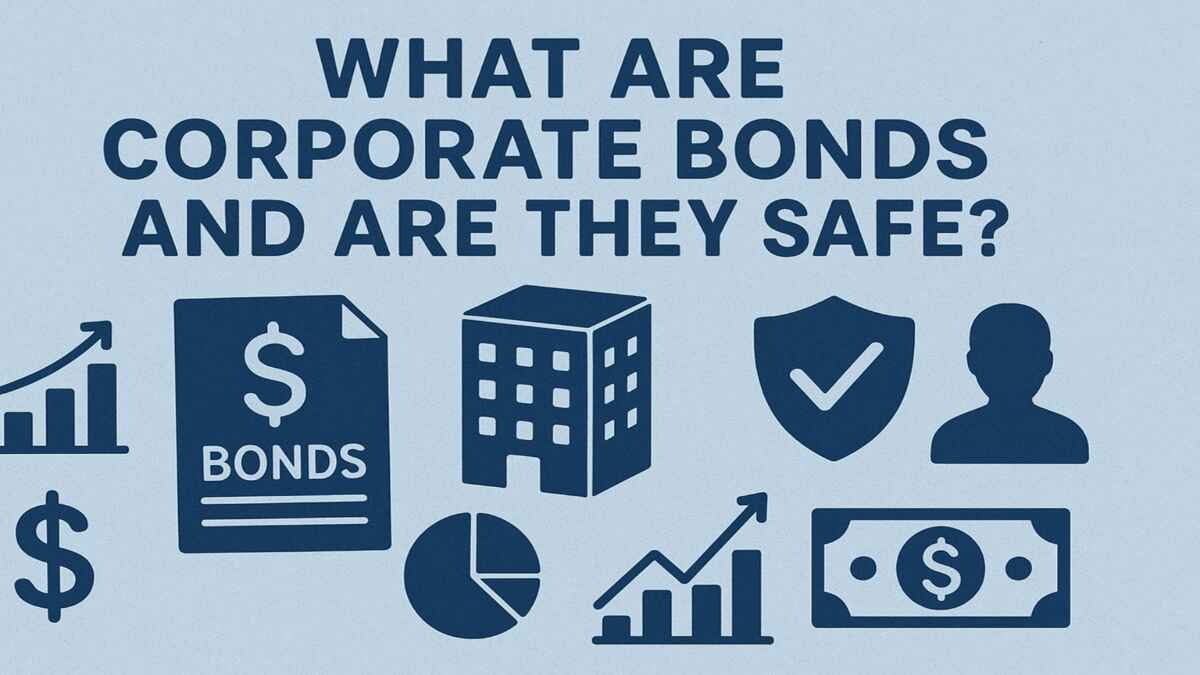
Corporate bonds are becoming a popular investment option in India for those seeking steady income with relatively low risk compared to stocks. But what exactly are corporate bonds, and are they safe? If you’re new to investing or looking to diversify your portfolio, understanding corporate bonds is key. In this article, we’ll break down everything you need to know about corporate bonds in simple English, explore their safety, and help you decide if they’re a good fit for your financial goals. Written with Indian investors in mind, this SEO-friendly guide is 100% unique, engaging, and designed to rank well on Google.What Are Corporate Bonds and Are They Safe?
Table of Contents
What Are Corporate Bonds?
Corporate bonds are debt instruments issued by companies to raise funds. When you buy a corporate bond, you’re essentially lending money to the issuing company. In return, the company promises to pay you interest periodically (usually semi-annually or annually) and return the principal amount when the bond matures.
For example, if you invest ₹10,000 in a corporate bond with a 7% annual interest rate and a 5-year maturity, the company will pay you ₹700 every year as interest. At the end of five years, you’ll get your ₹10,000 back, assuming the company doesn’t default.
In India, corporate bonds are issued by both private companies (like Reliance Industries or Tata Motors) and public sector undertakings (PSUs) like NTPC or Indian Oil Corporation. They’re different from government bonds, which are issued by the Reserve Bank saturday, August 09, 2025, and are considered safer but often offer lower returns.
Why Do Companies Issue Corporate Bonds?
Companies issue corporate bonds to:
- Fund expansion projects.
- Pay off existing debts.
- Finance day-to-day operations.
- Invest in new technologies or acquisitions.
For investors, corporate bonds offer a way to earn regular income without the volatility of stocks, making them attractive for conservative investors.
Types of Corporate Bonds in India
Corporate bonds in India come in various forms, each with unique features. Here are the main types:
- Fixed-Rate Bonds: These have a fixed interest rate throughout the bond’s tenure. Most corporate bonds in India fall under this category.
- Floating-Rate Bonds: The interest rate fluctuates based on a benchmark, like the repo rate or MIBOR (Mumbai Interbank Offered Rate).
- Zero-Coupon Bonds: These don’t pay periodic interest but are sold at a discount and redeemed at face value upon maturity.
- Perpetual Bonds: These have no maturity date and pay interest indefinitely, though they’re less common.
- Secured Bonds: Backed by specific assets of the company, offering more security.
- Unsecured Bonds: Not backed by collateral, carrying higher risk but often higher returns.
How Do Corporate Bonds Work?

When you invest in a corporate bond, here’s how it typically works:
- Face Value: The amount you’ll receive when the bond matures (e.g., ₹1,000).
- Coupon Rate: The interest rate the company pays you (e.g., 7% per year).
- Maturity: The duration until the bond matures, ranging from 1 to 10 years or more.
- Yield: The actual return you earn, which depends on the bond’s price and coupon rate.
You can buy corporate bonds through:
- Primary Market: When the company issues the bond directly.
- Secondary Market: Through stock exchanges like NSE or BSE, where bonds are traded.
In India, corporate bonds are often listed on exchanges, making them accessible to retail investors. You can also invest through mutual funds specializing in corporate bond funds for added diversification.
Are Corporate Bonds Safe?
The safety of corporate bonds depends on several factors. While they’re generally safer than stocks, they’re not risk-free. Let’s explore the risks and safety aspects of corporate bonds for Indian investors.
Factors Affecting the Safety of Corporate Bonds
- Credit Risk: The biggest risk is that the company may default on interest payments or fail to repay the principal. To assess this, check the bond’s credit rating. Agencies like CRISIL, ICRA, and CARE assign ratings (e.g., AAA, AA, A, BBB) based on the company’s financial health. AAA-rated bonds (e.g., from PSUs like NTPC) are the safest, while lower-rated bonds (BBB or below) are riskier but offer higher returns.
- Interest Rate Risk: If interest rates rise, the value of existing bonds with lower rates may fall, especially if you plan to sell before maturity. This is less of a concern if you hold the bond until maturity.
- Liquidity Risk: Some corporate bonds in India have low trading volumes, making it hard to sell them quickly without a price cut.
- Inflation Risk: If inflation rises, the fixed interest from bonds may lose purchasing power over time.
- Call Risk: Some bonds are “callable,” meaning the company can redeem them before maturity, potentially leaving you with lower returns if interest rates have fallen.
How Safe Are Corporate Bonds Compared to Other Investments?
- Versus Government Bonds: Corporate bonds carry higher risk than government bonds (like G-Secs), which are backed by the Government of India and considered virtually risk-free.
- Versus Fixed Deposits (FDs): Bank FDs are safer due to deposit insurance (up to ₹5 lakh per depositor per bank under DICGC). However, corporate bonds often offer higher returns.
- Versus Stocks: Corporate bonds are less volatile than stocks but offer lower potential returns.
For Indian investors, PSU bonds (e.g., from REC or PFC) are safer than private corporate bonds because they have implicit government backing. However, even PSU bonds aren’t as safe as government securities.
How to Evaluate the Safety of Corporate Bonds
To ensure you’re investing in safe corporate bonds:
- Check the Credit Rating: Stick to AAA or AA-rated bonds for lower risk.
- Research the Issuer: Look at the company’s financial health, debt levels, and profitability. For example, companies like Reliance or HDFC have strong track records.
- Diversify: Spread your investment across multiple bonds to reduce the impact of a single default.
- Understand the Terms: Check the bond’s tenure, coupon rate, and whether it’s secured or unsecured.
- Consult a Financial Advisor: If you’re new to bonds, professional advice can help you choose wisely.
Benefits of Investing in Corporate Bonds
Corporate bonds offer several advantages for Indian investors:
- Regular Income: Fixed interest payments provide a steady income stream, ideal for retirees or conservative investors.
- Higher Returns than FDs: AAA-rated corporate bonds often yield 1-2% more than bank FDs.
- Diversification: Adding bonds to a stock-heavy portfolio reduces overall risk.
- Capital Preservation: If held to maturity, you get your principal back (assuming no default).
- Tax Benefits: Certain bonds, like tax-free PSU bonds (e.g., NHAI or IRFC), offer tax-exempt interest, making them attractive for high-tax-bracket investors.
Risks of Corporate Bonds
While corporate bonds are relatively safe, they come with risks:
- Default Risk: If the company faces financial trouble, it may fail to pay interest or principal.
- Market Risk: Bond prices fluctuate with interest rates, affecting returns if sold early.
- Low Liquidity: Some bonds may be hard to sell in the secondary market.
- Taxation: Interest from most corporate bonds is taxable as per your income tax slab, unlike tax-free bonds.
How to Invest in Corporate Bonds in India
Here’s a step-by-step guide for Indian investors:
- Open a Demat Account: Most corporate bonds are traded on exchanges like NSE or BSE, so a demat account is necessary.
- Research Bonds: Use platforms like NSE’s bond section or financial websites to find bonds with good ratings and yields.
- Check Tax Implications: Understand whether the bond’s interest is taxable or tax-free.
- Invest Through Mutual Funds: If buying individual bonds is complex, consider corporate bond mutual funds for diversification.
- Monitor Your Investment: Keep track of the issuer’s financial health and market conditions.
Popular platforms in India for buying corporate bonds include Zerodha, ICICI Direct, and HDFC Securities. You can also invest through bond platforms like GoldenPi or Wint Wealth for curated bond options.
Taxation on Corporate Bonds in India
- Interest Income: Taxed as per your income tax slab (e.g., 30% for high earners).
- Capital Gains: If you sell bonds before maturity, short-term capital gains (less than 3 years) are taxed as per your slab, while long-term gains (3+ years) are taxed at 20% with indexation.
- Tax-Free Bonds: Interest from certain PSU bonds is exempt from tax, making them attractive for high-net-worth individuals.
Who Should Invest in Corporate Bonds?
Corporate bonds are ideal for:
- Retirees: Seeking regular income with low risk.
- Conservative Investors: Wanting higher returns than FDs without stock market volatility.
- High-Tax-Bracket Individuals: Especially for tax-free bonds.
- Portfolio Diversifiers: Balancing equity-heavy portfolios.
However, they may not suit aggressive investors seeking high returns or those with low risk tolerance who prefer FDs or government bonds.
Corporate Bonds vs. Other Fixed-Income Options
| Feature | Corporate Bonds | Government Bonds | Fixed Deposits |
|---|---|---|---|
| Risk | Moderate | Very Low | Low |
| Returns | 6-9% (AAA-rated) | 5-7% | 5-7% |
| Liquidity | Moderate | High | Low |
| Taxation | Taxable/Tax-Free | Taxable | Taxable |
| Safety | Depends on rating | Very Safe | Safe up to ₹5 lakh |
Recent Trends in Corporate Bonds in India (2025)
As of August 2025, corporate bonds remain a popular choice due to:
- Stable Interest Rates: The RBI’s repo rate has stabilized, making bond yields attractive.
- Growing Retail Participation: Platforms like Zerodha and Wint Wealth have made bonds accessible to retail investors.
- PSU Bond Demand: Tax-free bonds from PSUs like REC and PFC are in high demand due to their safety and tax benefits.
- Green Bonds: Companies are issuing bonds to fund eco-friendly projects, appealing to socially conscious investors.
Tips for Safe Investment in Corporate Bonds
- Stick to High Ratings: AAA or AA-rated bonds are safer bets.
- Hold to Maturity: This eliminates interest rate risk and ensures you get your principal back.
- Diversify Across Issuers: Don’t put all your money in one company’s bonds.
- Monitor Economic Conditions: Rising interest rates or inflation can impact bond values.
- Use Professional Help: If unsure, consult a SEBI-registered financial advisor.
Conclusion
Corporate bonds are a solid investment option for Indian investors seeking regular income and moderate risk. While they’re not as safe as government bonds or FDs, high-rated corporate bonds from reputable companies or PSUs offer a good balance of safety and returns. By understanding credit ratings, diversifying your portfolio, and holding bonds to maturity, you can minimize risks and maximize returns.
Whether you’re a retiree looking for steady income or a young investor diversifying your portfolio, corporate bonds can play a key role in your financial plan. Always research thoroughly, check the issuer’s financial health, and consider consulting a financial advisor before investing.
FAQs
Are corporate bonds safe for beginners?
Yes, corporate bonds can be safe for beginners if you choose high-rated (AAA or AA) bonds from reputable companies or PSUs. However, always understand the risks and diversify your investments.
How are corporate bonds different from stocks?
Corporate bonds are debt instruments offering fixed interest and principal repayment, while stocks represent ownership in a company with variable returns and higher risk.
Can I lose money in corporate bonds?
Yes, if the company defaults or if you sell the bond before maturity at a lower price due to rising interest rates. Sticking to high-rated bonds reduces this risk.
How do I buy corporate bonds in India?
You can buy corporate bonds through a demat account on exchanges like NSE or BSE, or via platforms like Zerodha, ICICI Direct, or bond-focused platforms like GoldenPi.
Are corporate bond mutual funds better than individual bonds?
Corporate bond mutual funds offer diversification and professional management, making them easier for beginners. However, they come with management fees and may have slightly lower returns.
What are tax-free corporate bonds?
Tax-free bonds, usually issued by PSUs like NHAI or IRFC, offer interest that is exempt from income tax, making them attractive for high-tax-bracket investors.
How do I check the safety of a corporate bond?
Check the bond’s credit rating (e.g., AAA, AA) from agencies like CRISIL or ICRA, research the issuer’s financial health, and ensure the bond aligns with your risk tolerance.
Can I sell corporate bonds before maturity?
Yes, you can sell bonds in the secondary market, but the price may vary based on interest rates and market conditions, potentially leading to a loss or gain.
What is the minimum investment for corporate bonds in India?
The minimum investment varies but is typically ₹10,000 for primary issues. In the secondary market, you can buy bonds in smaller lots, depending on the platform.
Are PSU bonds safer than private corporate bonds?
Yes, PSU bonds are generally safer due to implicit government backing, though they may offer slightly lower returns than private corporate bonds.
Disclaimer: Moneyjack.in provides general financial information for educational purposes only. We are not financial advisors. Content is not personalized advice. Consult a qualified professional before making financial decisions. We are not liable for any losses or damages arising from the use of our content. Always conduct your own research.