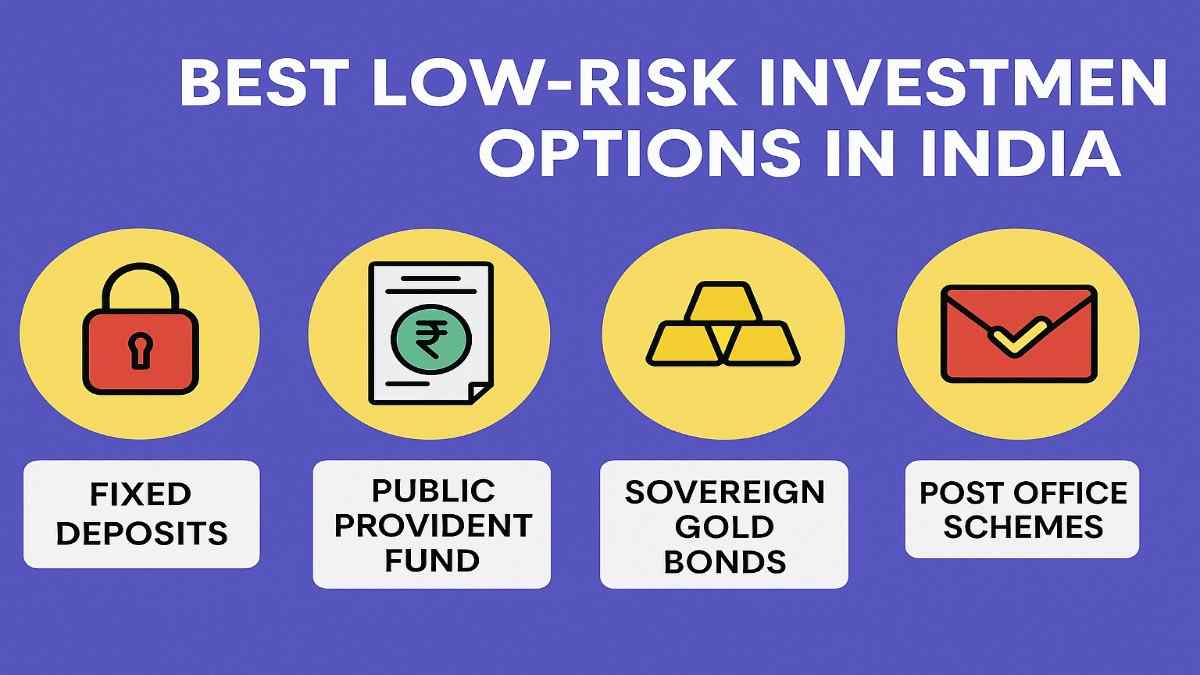
Hey there! If you’re someone who’s just starting to think about investing or maybe you’re already dipping your toes into the financial world but want to play it safe, then exploring the best low-risk investment options in India is a smart move. In a country like India, where the economy is booming but uncertainties like inflation and market volatility can pop up, low-risk investments help you grow your money steadily without losing sleep over it. As we step into 2025, with the current economic landscape showing stable growth post the global recovery, these options are more relevant than ever.
Let me break it down for you. Low-risk investments are those where the chance of losing your principal amount is minimal. They might not give you sky-high returns like stocks or cryptocurrencies, but they provide consistency, security, and often tax benefits. In India, the government and banks back many of these, making them reliable. According to recent data, with inflation hovering around 4-5% in mid-2025, these investments can help your money outpace rising costs without much hassle.
Understanding Fixed Deposits: A Cornerstone of the Best Low-Risk Investment Options in India
Fixed Deposits, or FDs, are probably the first thing that comes to mind when you think of safe investing in India. And for good reason—they’re straightforward, secure, and widely available. If you’re searching for the best low-risk investment options in India, FDs top the list because they’re insured by the Deposit Insurance and Credit Guarantee Corporation (DICGC) up to ₹5 lakh per depositor per bank. That means even if something goes wrong with the bank, your money is safe.
How do FDs work? You park a lump sum with a bank or non-banking financial company (NBFC) for a fixed period, say 1 to 5 years, and earn interest at a predetermined rate. As of August 2025, FD rates for general citizens range from 6% to 7.5% p.a., depending on the bank and tenure. For instance, SBI offers up to 6.50% for general public, while private banks like HDFC might go up to 7.10%. Senior citizens get an extra 0.5% bump, making it even more attractive for them.
Pros of FDs as one of the best low-risk investment options in India? Predictable returns—no surprises. You can choose flexible tenures, from 7 days to 10 years, and there’s a tax-saver variant under Section 80C. Plus, with online banking, opening an FD is as easy as ordering food. But cons? Interest is taxable as per your slab, and premature withdrawal attracts penalties, usually 1%. Also, in times of falling rates, you might lock in lower returns.
Let me share a quick example. Suppose you invest ₹1 lakh in a 3-year FD at 7%. You’ll earn about ₹22,500 in interest, growing your money to ₹1,22,500. That’s steady growth without risks. For those in higher tax brackets, consider company FDs from reputable NBFCs like Bajaj Finance, which offer slightly higher rates but check their ratings first.
In 2025, with digital FDs on the rise, you can even ladder them—split investments across different tenures to manage liquidity. If inflation stays low, FDs beat it hands down. Truly, when it comes to the best low-risk investment options in India, FDs are like that reliable friend who’s always there.
Public Provident Fund (PPF): Long-Term Security in the Best Low-Risk Investment Options in India
Shifting gears to something with tax perks, the Public Provident Fund (PPF) is a gem among the best low-risk investment options in India. Backed by the government, it’s perfect for long-term savers who want safety and deductions under Section 80C.
PPF lets you invest up to ₹1.5 lakh annually for 15 years, with extensions possible. The current interest rate as of August 2025 is 7.1% p.a., compounded annually, and it’s tax-free on maturity. That means your earnings grow faster without Uncle Sam taking a cut.
Why is PPF one of the best low-risk investment options in India? It’s EEE (exempt-exempt-exempt)—contributions, interest, and withdrawals are all tax-free. Great for retirement planning. You can start with as little as ₹500, and partial withdrawals are allowed after 7 years. But the lock-in is 15 years, so it’s not for short-term needs. Also, rates are reviewed quarterly, but they’ve been stable lately.
Picture this: A 30-year-old invests ₹1.5 lakh yearly at 7.1%. By age 45, they’d have around ₹40 lakh, all tax-free. That’s powerful compounding! In India, with rising life expectancies, PPF helps build a corpus without market worries. If you’re a salaried employee, combine it with EPF for double safety.
One tip: Open PPF accounts for your kids too—it’s allowed, and teaches them saving early. Among the best low-risk investment options in India, PPF stands out for its simplicity and government guarantee.
National Savings Certificate (NSC): Tax-Saving Star Among Best Low-Risk Investment Options in India
If you’re hunting for the best low-risk investment options in India with tax benefits, don’t overlook the National Savings Certificate (NSC). Issued by post offices, it’s a 5-year scheme that’s fully government-backed, making it ultra-safe.
The current rate is 7.7% p.a., compounded annually but paid at maturity. Invest from ₹1,000 upwards, no upper limit, and claim up to ₹1.5 lakh under 80C. Interest is taxable, but reinvested interest qualifies for deduction in the first four years.
Pros? Fixed returns, no market risk, and easy to buy online or at post offices. It’s ideal for conservative investors wanting steady growth. Cons? 5-year lock-in, and liquidity is low—premature closure only in extreme cases.
For example, ₹1 lakh in NSC grows to about ₹1,45,000 in 5 years. In 2025, with digital NSC via India Post app, it’s more accessible. Pair it with other schemes for diversification. Definitely a top pick in the best low-risk investment options in India for tax planners.
Senior Citizen Savings Scheme (SCSS): Tailored for Elders in Best Low-Risk Investment Options in India
For those over 60, the Senior Citizen Savings Scheme (SCSS) is a standout in the best low-risk investment options in India. Government-sponsored, it offers high rates and quarterly payouts—perfect for regular income.
Current rate: 8.2% p.a., with a 5-year tenure extendable by 3 years. Invest up to ₹30 lakh, and get 80C benefits. Interest is taxable, but TDS applies only if it exceeds ₹50,000 yearly.
Why top-notch? Highest rates among safe options, and payouts help with expenses. Available at banks and post offices. Drawback: Only for seniors, and premature withdrawal has penalties.
If you’re a retiree, ₹10 lakh in SCSS gives ₹20,500 quarterly. In India’s aging population, SCSS ensures dignity in golden years. It’s a must-consider among the best low-risk investment options in India for the elderly.
Government Bonds and Treasury Bills: Sovereign Safety in Best Low-Risk Investment Options in India
Diving into bonds, government securities like bonds and T-bills are pure gold for risk-averse folks. They’re the backbone of the best low-risk investment options in India, with zero default risk.
10-year G-sec yields around 6.43% as of now, while RBI Floating Rate Savings Bonds offer 8.05%. T-bills are short-term, maturing in 91-364 days, great for parking funds.
Buy via RBI Retail Direct or banks. Pros: Tax-efficient (indexation for long-term), and liquid. Cons: Yields fluctuate with rates.
In 2025, with bond markets digitized, it’s easier. For stability, they’re unbeatable in the best low-risk investment options in India.
Low-Risk Mutual Funds: Modern Twist on Best Low-Risk Investment Options in India
Mutual funds aren’t all risky—low-risk ones like arbitrage or debt funds are excellent. Among the best low-risk investment options in India, they offer 7-8% returns with minimal volatility.
For example, Kotak Equity Arbitrage Fund has returned 7.7%. Invest via SIPs, tax as debt funds.
Pros: Professional management, liquidity. Cons: Small market risk, fees.
In digital India, apps like Groww make it simple. Great for balancing portfolios.
Gold Investments: Timeless Hedge in Best Low-Risk Investment Options in India
Gold isn’t just jewelry—it’s a low-risk asset. Sovereign Gold Bonds (SGBs) give 2.5% interest plus price appreciation, tax-free on maturity.
ETFs and digital gold are convenient. Gold has returned 15-20% annually lately.
Pros: Inflation beater, diversification. Cons: No regular income, storage for physical.
In 2025, with gold prices stable, it’s a safe add-on to the best low-risk investment options in India.
National Pension Scheme (NPS): Retirement-Focused in Best Low-Risk Investment Options in India

NPS is for long-term, with 9-12% average returns. Choose asset mix—equity for growth, debt for safety.
Tax benefits under 80C and 80CCD(1B). Partial withdrawal after 3 years.
Pros: Low cost, tax perks. Cons: 40% annuity mandatory.
Ideal for salaried, it’s growing in popularity among the best low-risk investment options in India.
Savings Accounts and Post Office Schemes: Basic Yet Effective
High-interest savings accounts offer 4-7%, liquid and safe. Post office RD at 6.7%.
They’re entry-level in the best low-risk investment options in India.
Tips for Choosing the Best Low-Risk Investment Options in India
Assess goals, diversify, monitor rates. Use apps for tracking.
In conclusion, the best low-risk investment options in India provide peace and growth. Start small, stay informed.
FAQ
What are the best low-risk investment options in India for beginners?
FDs and PPF are great starters.
How do I choose among the best low-risk investment options in India?
Consider tenure, returns, taxes.
Are the best low-risk investment options in India taxable?
Varies—PPF no, FDs yes.
What’s the safest among best low-risk investment options in India?
Government-backed like PPF.
Can NRIs invest in best low-risk investment options in India?
Yes, in FDs, bonds.
How much return from best low-risk investment options in India?
6-8% typically.
Best low-risk investment options in India for seniors?
SCSS and senior FDs.
Impact of inflation on best low-risk investment options in India?
Choose beating inflation.
Where to buy best low-risk investment options in India?
Banks, post offices, apps.
Disclaimer: Moneyjack.in provides general financial information for educational purposes only. We are not financial advisors. Content is not personalized advice. Consult a qualified professional before making financial decisions. We are not liable for any losses or damages arising from the use of our content. Always conduct your own research.