
Investing is a powerful way to grow your wealth, but choosing the right investment can feel overwhelming, especially in a dynamic market like India. Gold, real estate, and stocks are among the most popular investment options for Indian investors, each offering unique benefits and challenges. This comprehensive guide compares these three avenues to help you decide where to invest your money in 2025. We’ll explore their characteristics, historical performance, current trends, tax implications, and practical tips, all tailored for an Indian audience. Whether you’re a beginner or a seasoned investor, this article will provide clarity to align your investments with your financial goals.”Gold vs Real Estate vs Stocks: Where to Invest in India? “
Table of Contents
Introduction
In India, investing is not just about growing wealth—it’s about securing your future in a country where cultural traditions, economic growth, and market opportunities intersect. Gold has long been a symbol of wealth and security, real estate offers tangible assets with income potential, and stocks provide a chance to own a piece of India’s booming corporate sector. Each option has its own appeal, but which one is right for you? The answer depends on your financial goals, risk tolerance, and investment horizon.
This article dives deep into gold, real estate, and stocks, comparing their pros and cons, historical returns, and future outlook. We’ll also provide practical tips on how to get started, discuss the impact of technology and government policies, and answer common questions to help you make an informed decision. By the end, you’ll have a clear understanding of where to invest your money in India.
Understanding Each Investment
To make an informed choice, let’s first understand what each investment entails and how it fits into the Indian context.
Gold
Gold holds a special place in Indian culture, used in weddings, festivals, and as a store of wealth. Beyond its cultural significance, it’s a popular investment due to its stability and global demand. Gold can be invested in through various forms:
- Physical Gold: Jewelry, coins, and bars are traditional choices. They’re tangible but require secure storage.
- Gold Exchange-Traded Funds (ETFs): These are traded on stock exchanges and track gold prices, offering liquidity without physical storage.
- Sovereign Gold Bonds (SGBs): Issued by the Reserve Bank of India, these bonds are denominated in grams of gold and pay a small interest rate (e.g., 2.5% annually).
- Digital Gold: Platforms like Paytm and PhonePe allow you to buy small amounts of gold digitally, making it accessible and convenient.
Historical Performance: Over the past 20 years, gold prices in India have risen from around Rs 3,000 per 10 grams in 2005 to over Rs 60,000 per 10 grams in 2025, delivering an annualized return of about 8-10%. Gold has been a reliable hedge during economic crises, such as the 2008 financial meltdown and the 2020 pandemic.
Current Trends: In 2025, gold prices are influenced by global factors like interest rates and geopolitical tensions. In India, demand remains strong due to cultural practices and inflation concerns, which hover around 5%. Gold’s role as a safe haven makes it attractive during uncertain times.
Real Estate
Real estate in India includes residential properties (apartments, villas, plots), commercial spaces (offices, retail), and industrial properties (warehouses, factories). It’s a favored investment for its potential to generate both capital appreciation and rental income.
- Residential Real Estate: Popular for both personal use and investment, with rental yields typically ranging from 2-4% in urban areas.
- Commercial Real Estate: Offers higher rental yields (4-8%) but requires more capital and management.
- Industrial Real Estate: Growing due to demand for logistics and warehousing, driven by e-commerce.
Historical Performance: Real estate prices in major cities like Mumbai, Delhi, and Bangalore have appreciated significantly, often doubling over the past decade in prime locations. For example, a property bought for Rs 50 lakh in Mumbai in 2014 could be worth Rs 1 crore or more in 2024, depending on the area.
Current Market Conditions: In 2025, India’s real estate sector is recovering strongly, fueled by urbanization, rising incomes, and government initiatives like the Housing for All scheme and infrastructure projects (e.g., Mumbai Metro). The Real Estate (Regulation and Development) Act (RERA) has increased transparency, boosting investor confidence.
Stocks
Stocks represent ownership in companies listed on exchanges like the BSE or NSE. They offer high growth potential but come with volatility.
- Blue-chip Stocks: Shares of established companies like Reliance Industries or HDFC Bank, known for stability and dividends.
- Mid-cap and Small-cap Stocks: Offer higher growth potential but are riskier.
- Sector-specific Stocks: Focus on industries like technology, healthcare, or consumer goods, which are thriving in India.
Historical Performance: The Indian stock market has been a top performer globally. The Nifty 50 index grew from 5,000 points in 2014 to over 23,000 points in 2024, delivering annualized returns of 15-18%. Stocks have outperformed gold and real estate in terms of capital appreciation over long periods.
Current Market Trends: In 2025, the Indian stock market is at record highs, driven by strong economic growth, corporate earnings, and foreign investments. However, high valuations in some sectors raise concerns about short-term corrections. Sectors like technology, renewable energy, and healthcare are expected to lead growth.
Advantages and Disadvantages
Each investment type has its strengths and weaknesses. Here’s a detailed look at what makes each option appealing or challenging.
Gold
Advantages:
- Hedge Against Inflation: Gold retains value when inflation rises, protecting purchasing power.
- High Liquidity: Easy to buy and sell, especially digital gold and ETFs.
- Cultural Value: In India, gold is a socially accepted form of wealth, often gifted during festivals and weddings.
- Global Demand: Its price is tied to international markets, providing stability.
- Low Maintenance: Digital gold and ETFs require no upkeep, unlike physical gold.
Disadvantages:
- No Regular Income: Gold doesn’t generate dividends or rent.
- Storage Costs: Physical gold needs secure storage, which can be expensive.
- Short-term Volatility: Prices can fluctuate, leading to potential losses if sold at the wrong time.
- Opportunity Cost: Money tied up in gold could earn higher returns elsewhere.
- Purity and Making Charges: Jewelry often involves extra costs and risks of impurity.
Real Estate

Advantages:
- High Returns: Properties in growing areas can double in value over a decade.
- Rental Income: Provides a steady income stream, especially in urban centers.
- Tax Benefits: Deductions on home loan interest (up to Rs 2 lakh) and principal repayment (up to Rs 1.5 lakh under Section 80C).
- Tangible Asset: Offers a sense of security as a physical asset.
- Hedge Against Inflation: Property values rise with inflation.
- Leverage: Mortgages allow you to invest with borrowed money, amplifying returns.
- Long-term Stability: Less volatile than stocks over extended periods.
Disadvantages:
- High Initial Cost: Requires significant capital, often lakhs or crores.
- Illiquidity: Selling property can take months or longer.
- Maintenance Costs: Ongoing repairs and upkeep can be costly.
- Regulatory Risks: Changes in laws or policies (e.g., RERA, GST) can impact returns.
- Vacancy Risk: Rental properties may sit empty, leading to income loss.
- Transaction Costs: Stamp duty, registration, and brokerage fees add up.
- Interest Rate Sensitivity: Rising rates can increase mortgage payments.
Stocks
Advantages:
- High Return Potential: Stocks have historically outperformed other assets, with returns of 15-18% annually over long periods.
- Liquidity: Can be bought and sold instantly through online platforms.
- Diversification: Invest across sectors to spread risk.
- Dividend Income: Many companies pay regular dividends.
- Accessibility: Start with small amounts via mutual funds or direct stocks.
- Regulated Market: SEBI ensures fairness and transparency.
- Global Exposure: Access international markets through ETFs or mutual funds.
Disadvantages:
- High Volatility: Prices can swing sharply, leading to losses.
- Risk of Loss: Poor company performance or market crashes can wipe out investments.
- Market Timing: Hard to predict the best times to buy or sell.
- Complexity: Requires research and knowledge, which can overwhelm beginners.
- No Guaranteed Returns: Unlike fixed deposits, stocks carry risk of capital loss.
- Emotional Stress: Market fluctuations can be stressful.
- Brokerage and Taxes: Fees and capital gains taxes reduce returns.
Comparison of Gold, Real Estate, and Stocks
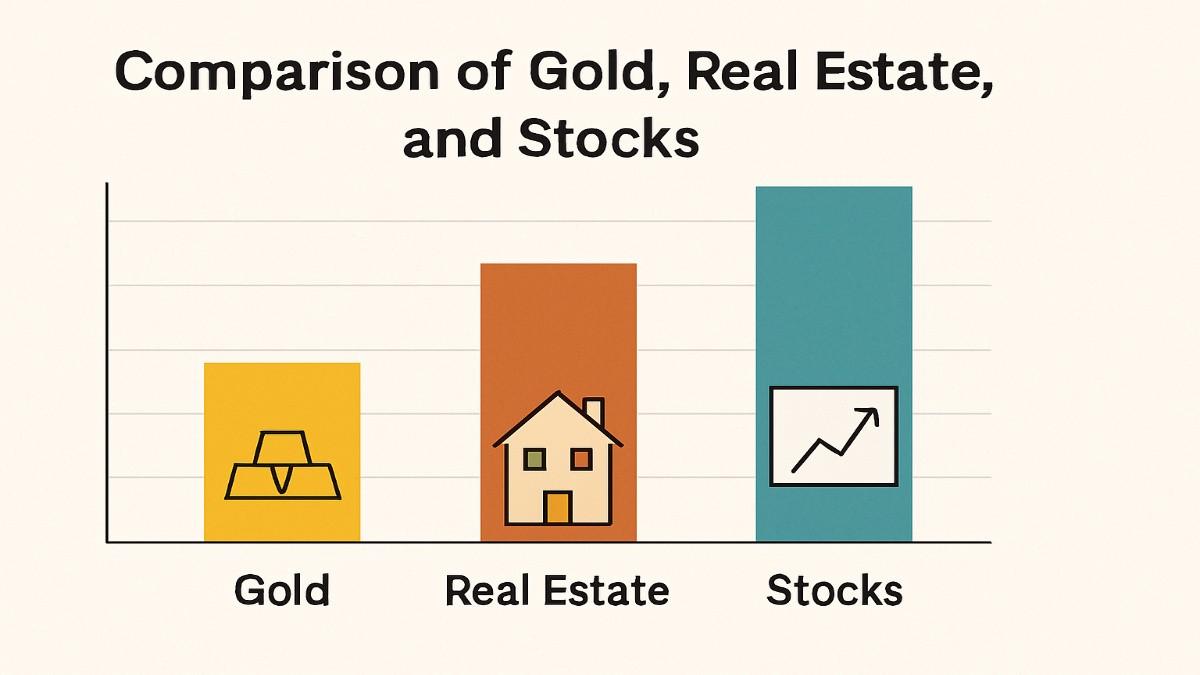
To choose the best investment, let’s compare these options across key factors.
Return on Investment (ROI)
| Investment | 10-Year Return (2014-2024) | Notes |
|---|---|---|
| Stocks | ~185% | Based on Nifty 50 index growth from 8,280 to 23,600 points. |
| Real Estate | ~100-200% | Varies by location; prime urban areas like Mumbai show higher returns. |
| Gold | ~140% | Price rose from Rs 25,000 to Rs 60,000 per 10 grams. |
Stocks have historically offered the highest returns, followed by real estate in prime locations. Gold provides steady but moderate growth.
Risk Levels
- Stocks: High risk due to market volatility and company-specific issues.
- Real Estate: Moderate risk, influenced by local market conditions and economic factors.
- Gold: Low risk, as it’s a safe haven, though short-term price swings occur.
Liquidity
- Stocks: Highly liquid; trades are executed in seconds.
- Gold: High liquidity, especially for ETFs and digital gold; physical gold may take longer to sell.
- Real Estate: Low liquidity; selling can take months.
Tax Implications
| Investment | Short-term Capital Gains | Long-term Capital Gains | Other Tax Benefits |
|---|---|---|---|
| Gold | Taxed at income slab rate (holding < 3 years) | 20% with indexation (holding > 3 years) | None |
| Real Estate | Taxed at income slab rate (holding < 2 years) | 20% with indexation (holding > 2 years) | Home loan interest (up to Rs 2 lakh), principal repayment (up to Rs 1.5 lakh) |
| Stocks | 15% (holding < 1 year) | 10% on gains above Rs 1 lakh (holding > 1 year) | Dividend distribution tax (if applicable) |
Real estate offers significant tax benefits, while stocks have favorable short-term tax rates. Gold has limited tax advantages.
Ease of Investment
- Stocks: Easy to start with small amounts via mutual funds or apps like Zerodha.
- Gold: Digital gold and ETFs are simple; physical gold involves storage logistics.
- Real Estate: Requires large capital and complex paperwork (e.g., title deeds, RERA compliance).
Case Studies: Hypothetical Investment Scenarios
Let’s explore how a Rs 10 lakh investment in each asset class would have performed over the past 10 years (2014-2024).
- Stocks: Investing in the Nifty 50 index would have grown Rs 10 lakh to Rs 36.69 lakh, a 185% return, based on the index rising from 8,280 to 23,600 points (India Today).
- Gold: At Rs 25,000 per 10 grams in 2014, Rs 10 lakh could buy 400 grams. At Rs 60,000 per 10 grams in 2024, this would be worth Rs 24 lakh, a 140% return.
- Real Estate: A Rs 10 lakh property in a tier-2 city with 8% annual appreciation would be worth Rs 21.59 lakh in 2024. With 3% rental yield, it would generate Rs 3 lakh in rent (before taxes and maintenance), totaling Rs 24.59 lakh.
During the 2020 pandemic, gold prices surged as stocks crashed, showing its role as a hedge. Real estate saw a temporary dip but recovered due to demand for larger homes.
How to Get Started
Gold
- Physical Gold: Buy from trusted jewelers or banks; verify purity and store securely.
- Gold ETFs: Open a demat account with brokers like Zerodha and buy ETF units.
- Sovereign Gold Bonds: Apply through banks or stock exchanges during issuance.
- Digital Gold: Use apps like Paytm or PhonePe for small, convenient purchases.
Real Estate
- Research: Study growth areas, infrastructure projects, and rental yields.
- Financing: Compare home loan rates from banks like SBI or HDFC.
- Legalities: Verify title deeds and ensure RERA compliance.
- Management: Consider property management services for rentals.
Stocks
- Demat Account: Open with brokers like Zerodha or Upstox.
- Research: Analyze company fundamentals or opt for mutual funds.
- Start Small: Begin with SIPs in mutual funds for diversification.
- Monitor: Regularly review and rebalance your portfolio.
Impact of Technology
Technology has transformed investing in India:
- Gold: Digital gold platforms enable fractional ownership and easy trading.
- Real Estate: Proptech platforms like NoBroker offer virtual tours and fractional ownership.
- Stocks: Online trading apps and robo-advisors make investing accessible and efficient.
Government Policies
- Gold: Import duties and taxes affect prices; SGBs reduce physical gold demand.
- Real Estate: RERA and GST have increased transparency; affordable housing schemes boost demand.
- Stocks: SEBI regulations ensure market integrity; capital gains tax policies influence returns.
Current Trends and Future Outlook
In 2025, India’s economy is projected to grow at 7%, benefiting all three asset classes:
- Gold: Likely to remain a safe haven amid global uncertainties, with moderate returns.
- Real Estate: Expected to grow due to urbanization and infrastructure projects, though regulatory changes and interest rates could pose challenges.
- Stocks: Strong long-term prospects in sectors like technology and healthcare, but high valuations may limit short-term gains.
Experts recommend diversifying across all three to balance growth, income, and security (Bajaj Finserv).
FAQs
Which investment is best for beginners?
Mutual funds or gold ETFs are easier due to low entry barriers and professional management.
Can I lose money in gold?
Yes, short-term price fluctuations can lead to losses if sold at the wrong time.
Is real estate good during a recession?
It can be a buying opportunity due to lower prices, but rental income may dip initially.
How do I choose stocks?
Research company fundamentals or invest in mutual funds for diversification.
What’s the best way to invest in gold?
Sovereign gold bonds or ETFs are convenient and secure compared to physical gold.
Conclusion
Gold, real estate, and stocks each offer unique benefits for Indian investors. Gold provides safety and cultural value, real estate offers stability and income, and stocks deliver high growth potential. The best choice depends on your goals: gold for security, real estate for steady income, or stocks for wealth creation. A diversified portfolio combining all three can balance risk and reward.
Before investing, research thoroughly and consider consulting a financial advisor. Align your investments with your risk tolerance and financial aspirations to build a secure future.
Disclaimer: Moneyjack.in provides general financial information for educational purposes only. We are not financial advisors. Content is not personalized advice. Consult a qualified professional before making financial decisions. We are not liable for any losses or damages arising from the use of our content. Always conduct your own research.