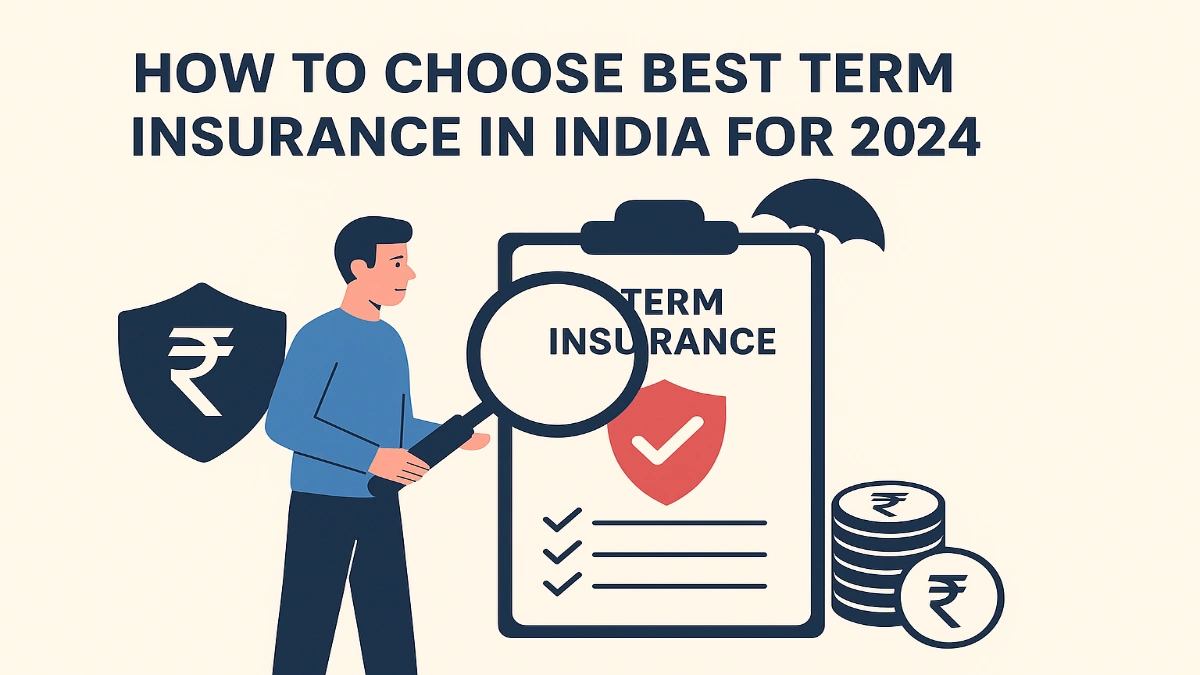
Securing your family’s financial future is not just an act of love; it’s a fundamental responsibility. In the vast landscape of financial planning, few instruments are as pure and powerful as a term insurance plan. It’s a straightforward promise – a promise that your loved ones will be able to maintain their dreams and lifestyle, even in your absence.
But here’s the catch: with over two dozen life insurance companies in India, each offering multiple variants of term plans, how do you navigate this maze? How to Choose Best Term Insurance in India is a question that plagues every prudent individual. This guide is designed to be your definitive roadmap. We will demystify the process, break down the jargon, and equip you with the knowledge to make a decision you won’t regret.
Table of Contents
Chapter 1: Term Insurance 101 – Understanding the Bedrock of Financial Security
Before we dive into the “how,” let’s solidify the “what” and “why.”
What Exactly is a Term Insurance Plan?
A term insurance plan is the simplest and most affordable form of life insurance. You pay a regular premium (monthly, quarterly, yearly) to the insurance company for a pre-defined period (the ‘term’ – e.g., 20, 30, or 40 years). In return, the insurer promises to pay a lump sum amount (the ‘sum assured’) to your nominated beneficiaries (family members) if an unfortunate event leads to your demise during the policy term.
If you outlive the policy term, the coverage ceases, and you don’t get any money back. This “no survival benefit” feature is why premiums are so low compared to other insurance products.
Why is Term Insurance Non-Negotiable?
- High Coverage at Low Cost: It provides a substantial life cover (e.g., ₹1 Crore, ₹2 Crore) for a premium that is often less than your monthly coffee budget. No other investment or insurance product offers this kind of leverage.
- Pure Protection: Its sole purpose is to provide a financial safety net. It’s not cluttered with investment components, which keeps costs low and benefits high.
- Income Replacement: For a earning member of a family, the sum assured acts as a replacement for the lost income, ensuring that the family’s daily needs, goals, and aspirations are not compromised.
- Debt Protection: It can be used to cover large liabilities like a home loan, car loan, or personal loan, ensuring your family isn’t burdened by debt in your absence.
- Peace of Mind: It is the ultimate tool for peace of mind, allowing you to live your life today without anxiety about tomorrow’s uncertainties.
Chapter 2: The 10-Step Checklist for How to Choose Best Term Insurance in India
This is the core of our guide. Follow these steps meticulously to find the perfect plan for you.
Step 1: Determine the Right Sum Assured (Coverage Amount)
This is the most critical step. An inadequate sum assured defeats the very purpose of the insurance.
How to Calculate it?
A common thumb rule is to have a cover that is 10-15 times your annual income. However, a more scientific approach is the Human Life Value (HLV) method.
HLV Calculation:
Consider your annual income, deduct taxes and your personal expenses. The remainder is the amount your family depends on. Now, multiply this by the number of years you expect to continue working (years to retirement). You should also factor in:
- Outstanding Liabilities: Home loan, car loan, other debts.
- Future Goals: Your children’s education and wedding costs.
- Living Expenses: Day-to-day household costs, accounting for inflation.
- Medical and Emergency Fund.
Example: A 30-year-old earning ₹12 lakhs per year, with personal expenses of ₹2 lakhs, has a family income of ₹10 lakhs. With 30 years to retirement, the basic HLV is ₹3 Crores. Now, add a home loan of ₹50 lakhs and estimated education costs of ₹1 Crore. The total recommended sum assured would be ₹4.5 Crores.
- Pro Tip: Always err on the side of a higher cover. Inflation will erode the value of money over time.
Step 2: Choose the Optimal Policy Term
Your policy term should be long enough to cover your highest financial responsibilities.
- A simple rule is to choose a term that extends until your expected retirement age (e.g., 60 or 65 years). If you are 30, opt for a 35-year term.
- If you have a young child, ensure the policy term lasts at least until they are financially independent.
- If you have a 20-year home loan, your term plan should cover those 20 years at a minimum.
Step 3: Select the Right Type of Term Plan
Term insurance isn’t one-size-fits-all. Choose the variant that aligns with your needs.
- Level Term Plan: The most common type. The sum assured remains constant throughout the policy term. Premiums are fixed and usually the most affordable.
- Increasing Term Plan: The sum assured increases every year by a fixed percentage (e.g., 5%) to help combat inflation. Premiums are higher than a level term plan.
- Decreasing Term Plan: The sum assured decreases over time, typically in line with a reducing debt like a home loan. Premiums are the lowest. Ideal purely for covering a specific loan.
- Return of Premium (TROP): If you survive the policy term, you get back all the premiums paid. It sounds attractive but comes with a significantly higher premium. The money you get back is eroded by inflation. A Level Term Plan + a disciplined SIP often yields a much better return.
- Term Plan with Riders: These are add-ons that provide extra protection for specific scenarios (we’ll cover this in detail next).
Step 4: Don’t Ignore the Power of Riders
Riders enhance your coverage for a small additional premium. The most useful ones are:
- Accidental Death Benefit Rider: Pays an additional sum assured (e.g., equal to the base sum assured) if death occurs due to an accident.
- Critical Illness Rider: Pays a lump sum amount upon the diagnosis of any of the listed critical illnesses (e.g., cancer, heart attack, stroke). This money is for treatment and not for income replacement.
- Permanent Disability Rider: Provides a monthly income or a lump sum if you become permanently disabled due to an accident.
- Waiver of Premium Rider: If you are diagnosed with a critical illness or become disabled, all future premiums are waived off, but the policy continues.
Recommendation: The Accidental Death and Critical Illness riders are highly recommended for comprehensive protection.
Step 5: Compare, Compare, Compare!
Never buy the first policy you see. Use online insurance web aggregators (like Policybazaar, Coverfox, etc.) to compare plans from different insurers based on:
- Premium cost for your required sum assured and term.
- Claim Settlement Ratio (CSR) – More on this below.
- Insurer’s reputation and customer service reviews.
- Key features and exclusions.
Step 6: Scrutinize the Insurer’s Claim Settlement Ratio (CSR)
This is arguably the most important metric after the premium. The Claim Settlement Ratio is the percentage of claims the insurance company has paid out in a financial year.
- Formula: (Number of claims approved / Total number of claims received) * 100
- What to look for: Always choose an insurer with a consistently high CSR (above 95% is excellent). This data is published annually by IRDAI. A high CSR indicates the company’s reliability and willingness to honor its commitments.
Step 7: Evaluate the Insurer’s Solvency Ratio
The Solvency Ratio is a measure of the financial strength of an insurance company. It indicates whether the company has enough assets to meet its long-term debt obligations and all future claims.
- IRDAI mandates a minimum solvency ratio of 1.5.
- A ratio significantly higher than 1.5 (e.g., 2.0 or above) indicates a very strong financial position and a higher ability to withstand market volatility and pay large claims.
Step 8: Understand the Exclusions Thoroughly
Every policy document has a section on “exclusions” – situations where the claim will not be paid. The common exclusions are:
- Suicide within the first 12 months of the policy.
- Death due to pre-existing diseases within the first 1-3 years (varies by policy).
- Death under the influence of drugs or alcohol.
- Death due to engaging in a hazardous activity or adventure sports (unless declared and covered with extra premium).
- Death due to war, invasion, or acts of foreign enemies.
Read this section carefully and ask the insurer to clarify any doubts.
Step 9: Be Brutally Honest in Your Medical Declaration
This is the foundation of a hassle-free claim process.
- Disclose everything: Your smoking habits, drinking habits, pre-existing medical conditions (like diabetes, hypertension, etc.), family medical history, and any past surgeries.
- Consequences of Non-Disclosure: If you hide any information and it is discovered during the claim investigation, the insurer has the right to reject the claim and forfeit all premiums paid. The principle of “utmost good faith” (Uberrimae Fidei) is paramount in insurance.
- You might have to undergo a medical exam if you are above a certain age or opt for a high sum assured. Cooperate fully.
Step 10: The Devil is in the Details – Policy Wordings
Before you sign, read the policy document carefully. Pay attention to:
- Free Look Period: You usually have 15-30 days to review the policy terms. If you are not satisfied, you can cancel it and get a refund.
- Grace Period: The number of days (usually 15-30) after the premium due date during which you can pay the premium without the policy lapsing.
- Revival Period: If you fail to pay the premium even after the grace period, the policy lapses. You can revive it within a certain period (usually 2 years) by paying all outstanding premiums with interest.
- Suicide Clause: Understand the terms clearly.
- Settlement Options: How will the sum assured be paid to your nominees? Lump sum, monthly income, or a combination?
Chapter 3: Advanced Considerations and Common Pitfalls to Avoid
Buying Online vs. Through an Agent
| Feature | Online Term Plan | Offline Term Plan (via Agent) |
|---|---|---|
| Premium | Lower. No agent commissions, so costs are reduced. | Higher due to agent commissions and distribution costs. |
| Guidance | Self-guided. Requires your own research. | Personal guidance and hand-holding from the agent. |
| Convenience | High. Can be bought anytime, anywhere. | Requires meetings and physical paperwork. |
| Process | Fully digital, from purchase to issuance. | Involves physical forms and longer processing time. |
Verdict: If you are comfortable with online research and processes, an online plan is cost-effective. If you need personalized advice and are not tech-savvy, an agent can help, but ensure they are reputable.
Common Mistakes to Avoid
- Underinsuring: Choosing a low sum assured to save a few rupees on premium is the biggest mistake.
- Delaying the Purchase: Premiums are lowest when you are young and healthy. Every year you delay, the premium increases.
- Hiding Medical Information: As explained, this can be catastrophic.
- Not Nominating Correctly: Ensure your nominee’s details are 100% accurate and updated in case of life changes (marriage, birth, etc.).
- Not Reviewing the Policy: Life changes. A promotion, a new child, a new loan – all are reasons to review and enhance your coverage.
Chapter 4: The Claim Process – Ensuring a Smooth Experience for Your Family
Your responsibility doesn’t end with buying the policy. You must ensure your family knows how to file a claim.
- Intimation: The nominee must intimate the insurance company about the claim as soon as possible via call/email/website.
- Document Submission: The nominee will need to submit the duly filled claim form along with supporting documents:
- Original policy document
- Death certificate (original and copy)
- Nominee’s identity proof
- Medical records (if required)
- FIR/Postmortem report (in case of accidental death)
- Claim Processing: The insurer will verify the documents and may investigate if the claim is within the first few years or under suspicious circumstances.
- Claim Settlement: Once approved, the sum assured is disbursed to the nominee’s bank account. As per IRDAI norms, insurers must settle a claim within 30 days of receiving all documents.
Pro Tip: Keep a physical file with all policy details, login credentials, and customer care numbers in a place your family knows about.
Conclusion: Your Action Plan
Choosing the best term insurance is a systematic process, not an impulse decision. It is the cornerstone of a robust financial plan.
- Start Today: Don’t procrastinate. Use online calculators to get an estimate of your premium.
- Use Comparison Tools: Visit aggregator websites to see plans side-by-side.
- Shortlist 2-3 Insurers: Based on high CSR, low premium, and good features.
- Initiate the Application: Fill the form with utmost honesty.
- Get Medically Examined (if required).
- Receive the Policy Document: Read it thoroughly in the free look period.
- Inform Your Family: Ensure your nominee and immediate family are aware of the policy and its details.
Securing a term insurance plan is a profound gesture of care. It’s your voice of reassurance to your family, echoing long after you are gone, telling them that you have thought of them, that they are protected, and that their world, though changed, will not fall apart. Make that choice today.
FAQ:-
What is the ideal age to buy a term plan?
The sooner, the better. The ideal age is in your mid-20s to early 30s, as soon as you start earning. Premiums are at their lowest, and you lock in your health status.
Can I buy term insurance if I have diabetes or hypertension?
Yes. Most insurers will offer a policy, but it may be with a slightly higher premium (loading) depending on the severity and control of the condition. Full disclosure is mandatory.
How does smoking or tobacco use affect my premium?
It significantly increases the premium (often by 25-50%) as it categorizes you as a higher-risk individual. You must declare it truthfully.
Is the premium paid for term insurance tax deductible?
Yes. The premiums paid are eligible for deduction under Section 80C of the Income Tax Act up to ₹1.5 Lakh. The death benefit received by the nominee is completely tax-free under Section 10(10D).
Can I increase my coverage later?
Some policies offer a guaranteed insurability option as a rider, which allows you to increase coverage at specific life events (e.g., marriage, child birth) without a new medical exam. Otherwise, you would need to buy a new policy.