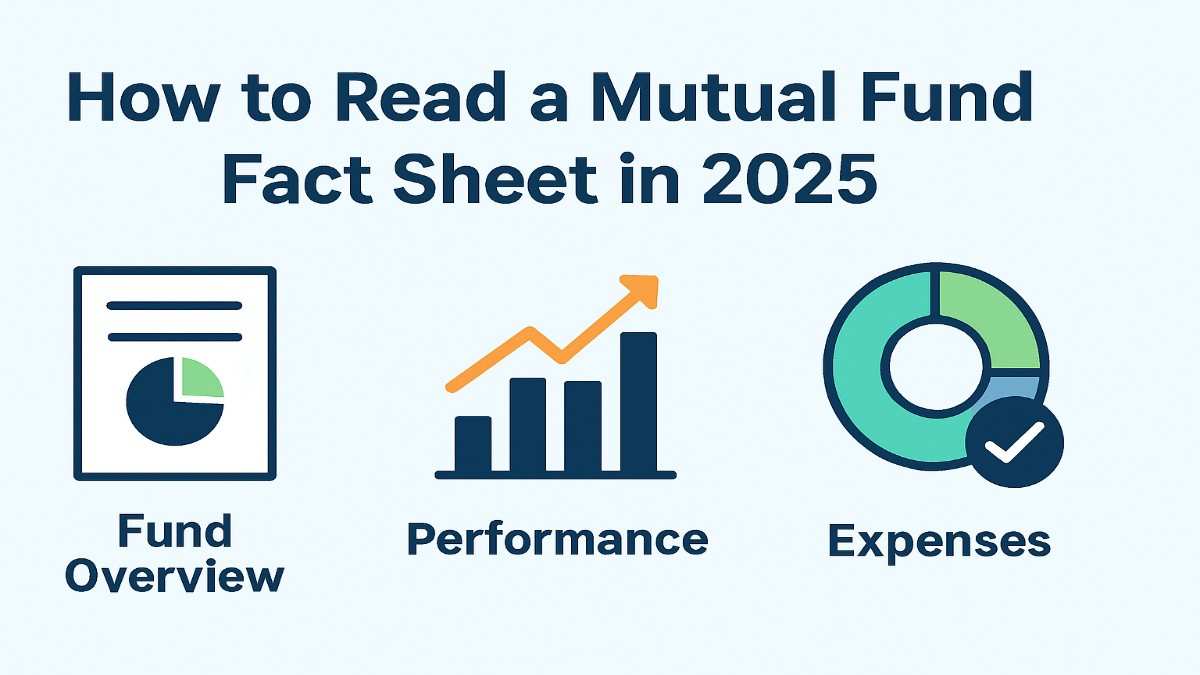
Introduction to Mutual Fund Fact Sheets
When it comes to investing in 2025, one phrase you will hear again and again is “How to Read a Mutual Fund Fact Sheet in 2025: A Beginner’s Roadmap to Smarter Investing.” This phrase may sound long and technical, but in reality, it’s simply your entry ticket to becoming a smarter, more confident investor in India.
A mutual fund fact sheet is like the report card of a student, but instead of grades in math and science, it shows performance in terms of returns, holdings, expenses, and risks. Every Asset Management Company (AMC) in India is required by the Securities and Exchange Board of India (SEBI) to publish a fact sheet for its funds each month. That means whether you’re investing in SBI Mutual Fund, HDFC Mutual Fund, or ICICI Prudential, you can get access to this document free of cost.
But why is this important? Well, think about it. Would you buy a car without checking its mileage, engine capacity, and safety rating? Probably not. Similarly, in 2025, you should never invest in a mutual fund without first going through its fact sheet. It’s a one-stop source of truth that helps you compare funds, check their strengths, and decide if they fit your financial goals.
Another reason why How to Read a Mutual Fund Fact Sheet in 2025: A Beginner’s Roadmap to Smarter Investing is a critical topic is because most beginners rely too much on advice from friends, relatives, or influencers on social media. While tips can be helpful, they are not a substitute for hard facts. The fact sheet is unbiased, data-driven, and standardized, which means you can compare one fund with another without any confusion.
In India, more and more first-time investors are entering the mutual fund market thanks to apps like Groww, Zerodha Coin, and Paytm Money. However, without the skill of reading fact sheets, many end up choosing funds based only on flashy advertisements or recent performance. That’s risky. By learning how to read a mutual fund fact sheet in 2025, you’re not just learning a skill—you’re protecting your hard-earned money and setting yourself on the path to wealth creation.
Also read: How to Select the Best Mutual Fund Scheme in India
Table of Contents
What is a Mutual Fund Fact Sheet?
If you’ve never seen one before, you might wonder what exactly a mutual fund fact sheet looks like. Simply put, it’s a one-to-two-page document (sometimes longer for detailed funds) that provides all the essential information about a mutual fund in a crisp, easy-to-read format.
Think of it as a resume of the fund. Just like a resume tells you about a person’s skills, experience, and achievements, a fact sheet tells you about a mutual fund’s objectives, performance, holdings, risk profile, and costs. Every fact sheet follows a somewhat similar structure, thanks to SEBI regulations in India, so once you learn the basics, you can read almost any fund’s fact sheet confidently.
Typically, a mutual fund fact sheet in 2025 will include:
- Fund Objective & Investment Strategy – Why the fund exists and how it invests.
- Performance Data – Historical returns (1-year, 3-year, 5-year, and since inception).
- Riskometer – A visual tool that shows whether the fund is low risk, moderate risk, or high risk.
- Fund Manager Information – Who manages the fund and their track record.
- Portfolio Holdings – Top 10 companies or bonds in which the fund has invested.
- Expense Ratio – The cost you pay annually for managing the fund.
- Benchmark Index – A standard market index (like NIFTY 50 or Sensex) to compare fund performance.
When people search for How to Read a Mutual Fund Fact Sheet in 2025: A Beginner’s Roadmap to Smarter Investing, they’re essentially asking: “How do I understand all these numbers and charts without getting lost?” The good news is—you don’t need to be a financial expert. The fact sheet is made for everyday investors, including beginners like you.
Here’s a fun analogy: Imagine you’re at a restaurant. The menu card tells you the name of the dish, ingredients, price, and whether it’s spicy or mild. Similarly, the fact sheet tells you what the mutual fund “serves,” how much it “costs” you (expense ratio), and how “spicy” it is in terms of risk. The only difference is—you’re making a decision about your financial health, not just your dinner.
Also read: What Are Equity Mutual Funds?
Why Investors in India Must Learn to Read It in 2025
India’s financial landscape in 2025 is very different from what it was a decade ago. Back then, people mostly trusted bank FDs, gold, or real estate for savings. Today, however, millions of Indians are exploring mutual funds as a preferred route to wealth creation. According to AMFI (Association of Mutual Funds in India), the mutual fund industry has crossed ₹50 trillion in assets under management (AUM). That’s massive growth!
But with growth comes confusion. There are now thousands of mutual fund schemes—equity funds, debt funds, hybrid funds, index funds, international funds, sectoral funds—the list goes on. If you’re a beginner, choosing the right one feels like standing in front of a supermarket aisle with hundreds of cereal boxes. How do you decide which one is right for you?
That’s where learning How to Read a Mutual Fund Fact Sheet in 2025: A Beginner’s Roadmap to Smarter Investing becomes not just useful, but essential. By reading a fact sheet, you can:
- Save yourself from misleading advertisements – Ads often highlight short-term performance, but fact sheets show long-term data.
- Compare funds fairly – Two funds may look similar, but one may have a much higher expense ratio or risk level.
- Match funds to your financial goals – If your goal is to save for your child’s education in 10 years, you’ll need a different type of fund than if you’re saving for a vacation in 2 years.
- Understand hidden risks – Sometimes a fund invests heavily in one sector (like technology or banking). Fact sheets show you these details upfront.
In 2025, SEBI has also made fact sheets more standardized and transparent, meaning you get clearer data than ever before. This makes it the perfect time for beginners to learn the skill. Just like reading a food label helps you eat healthier, reading a fact sheet helps you invest smarter.
Also read: Stock Market vs Mutual Funds Which Is Better?
Basics of Mutual Funds in India

Basics of Mutual Funds in India
Before we go deeper into fact sheets, let’s step back and understand the basics. What is a mutual fund, and why is it important in India in 2025?
A mutual fund is essentially a pool of money collected from many investors (like you and me). This pool is managed by professional fund managers who invest it into different assets like stocks, bonds, gold, or international markets. The main advantage is that even if you have only ₹500 or ₹1,000 to start, you get access to a diversified portfolio that would otherwise require lakhs of rupees to build on your own.
There are different types of mutual funds in India:
- Equity Funds – Invest mainly in stocks. High risk, high return.
- Debt Funds – Invest in bonds and government securities. Lower risk, steady return.
- Hybrid Funds – A mix of equity and debt. Balanced risk.
- Index Funds & ETFs – Track market indices like NIFTY 50. Low cost, passive returns.
- Sectoral/Thematic Funds – Focus on one sector like technology, pharma, or banking. High risk.
Now, where does the fact sheet come in? Well, with so many fund types, it’s easy to get confused. A fact sheet is like a cheat sheet that tells you exactly what the fund is doing with your money.
When we say How to Read a Mutual Fund Fact Sheet in 2025: A Beginner’s Roadmap to Smarter Investing, what we really mean is this: “Learn how to decode the facts so that you don’t have to blindly trust advertisements or influencers.”
In 2025, mutual funds have become more accessible thanks to SIPs (Systematic Investment Plans), which allow you to start investing with as little as ₹500 per month. But whether you’re investing ₹500 or ₹50,000, the principle remains the same: Don’t invest blindly. Read the fact sheet first.
Also read: What Is Exit Load in Mutual Funds?
How Fact Sheets Make Investing Easier
If mutual funds are the vehicles of wealth creation, then fact sheets are the Google Maps of investing. They guide you, show you the routes, warn you of risks, and help you avoid wrong turns. Without them, you’re basically driving blind.
Here’s how fact sheets make your investing journey easier in 2025:
- Clarity in Objectives – They clearly state what the fund is trying to achieve (capital growth, income generation, or stability).
- Transparency in Performance – You can see how the fund has performed not just recently, but over many years.
- Risk Awareness – With tools like the Riskometer, you instantly know whether the fund suits your risk appetite.
- Cost Visibility – Expense ratios are shown clearly, so you know exactly how much you’re paying the AMC.
- Manager Accountability – By showing the fund manager’s name and history, fact sheets help you evaluate who’s driving your money.
For beginners in India, fact sheets are even more valuable because they save you from being overwhelmed by financial jargon. Instead of reading a 100-page annual report, you can just read a 2-page fact sheet and get 90% of the information you need.
That’s why the phrase How to Read a Mutual Fund Fact Sheet in 2025: A Beginner’s Roadmap to Smarter Investing is repeated so often in financial education circles. It’s not just about reading—it’s about making investing simpler, safer, and smarter for everyone.
Also read: What Are ELSS Mutual Funds?
Key Sections of a Mutual Fund Fact Sheet
When you first open a mutual fund fact sheet in 2025, it might look overwhelming. Charts, numbers, ratios, and graphs seem to be everywhere. But once you know what each section means, reading it becomes as easy as reading the sports page of a newspaper. To make it simple, let’s break down the key sections that appear in almost every fact sheet in India.
- Fund Objective and Strategy – This tells you why the fund exists and what it aims to achieve. For example, an equity fund may say its objective is “long-term capital appreciation by investing in large-cap companies.”
- Riskometer – A small but powerful visual tool, usually a half-circle or meter, that tells you whether the fund is “Low,” “Moderate,” or “Very High Risk.”
- Fund Manager Profile – Who is handling your money? The fact sheet shows the fund manager’s experience, background, and track record.
- Performance Data – Tables or graphs that show how much the fund has returned in the last 1 year, 3 years, 5 years, and since inception.
- Portfolio Holdings – A list of the top stocks or bonds in which your money is currently invested.
- Expense Ratio – How much the AMC charges annually to manage your money.
- Benchmark – The index the fund is compared against, like NIFTY 50 or Sensex.
When you keep repeating the phrase How to Read a Mutual Fund Fact Sheet in 2025: A Beginner’s Roadmap to Smarter Investing, it becomes clear that understanding these sections is the “roadmap.” Once you decode these seven areas, you’ll have the ability to compare funds side by side and make confident investment choices.
Remember, each section tells a different story. The objective tells you where the fund wants to go, the riskometer tells you how bumpy the ride might be, and the performance table tells you how well the vehicle has done in the past. When read together, they give you a complete picture of whether this mutual fund is the right fit for you.
Also read: Top 5 Mistakes to Avoid While Investing in Mutual Funds
Fund Objective and Strategy
Every mutual fund begins with a purpose, and that purpose is captured in the fund objective section of the fact sheet. This is often the very first piece of information you’ll see. It’s usually written in one or two short paragraphs, but don’t be fooled by its simplicity—it’s one of the most important parts.
For example, an equity fund might say:
“The investment objective of the scheme is to generate long-term capital appreciation by investing predominantly in equity and equity-related instruments of large-cap companies.”
This short statement tells you three critical things:
- The goal is long-term capital appreciation (not short-term gains).
- The instruments are equity and equity-related (high risk, potentially high reward).
- The focus is large-cap companies (relatively safer compared to mid- or small-cap).
In 2025, beginners in India often make the mistake of skipping this section and jumping straight to returns. That’s like buying medicine by only looking at the flavor, not the purpose! If you don’t match the objective of the fund with your personal financial goal, you risk disappointment.
For example:
- If your goal is to buy a house in 3 years, you should not choose a fund with a long-term capital appreciation objective. Instead, a short-duration debt fund would be more appropriate.
- If your goal is retirement 25 years away, an equity growth fund with a long-term horizon would make sense.
That’s why, when discussing How to Read a Mutual Fund Fact Sheet in 2025: A Beginner’s Roadmap to Smarter Investing, the fund objective is like the destination in your GPS. If you don’t know where you want to go, the rest of the journey won’t make sense.
Also read: How to Choose the Right Mutual Fund for Beginners
Riskometer: Understanding Risk Levels in 2025
The Riskometer is one of the most beginner-friendly tools introduced by SEBI, and in 2025, it has become even more standardized and accurate. This little half-circle chart is often ignored, but it’s one of the most powerful parts of the fact sheet because it shows you exactly how risky your investment could be.
The categories usually include:
- Low Risk – Suitable for conservative investors (like liquid or short-duration debt funds).
- Moderate Risk – Balanced options like hybrid funds.
- High Risk – Equity funds, thematic funds, or sector-specific funds.
- Very High Risk – Small-cap equity funds, international thematic funds, or highly volatile categories.
For beginners in India, the Riskometer is like a warning sign on the road. If you’re driving into the mountains, you’ll see signs that say “sharp curves ahead” or “falling rocks possible.” Similarly, the Riskometer warns you about potential volatility in your investments.
In 2025, SEBI has also mandated that fact sheets explain why a fund falls into a particular risk category. For example, a small-cap equity fund may say:
“This scheme falls under Very High Risk due to significant exposure to small-cap companies that may experience high volatility.”
When people search for How to Read a Mutual Fund Fact Sheet in 2025: A Beginner’s Roadmap to Smarter Investing, understanding the Riskometer is one of the first answers. Because no matter how attractive the returns look, if the risk level doesn’t match your personal risk appetite, the fund is not for you.
Also read: What Is NAV in Mutual Funds? Explained Simply
Fund Manager’s Profile and Experience
Imagine boarding a plane without knowing who the pilot is. Scary, right? Similarly, when you invest in a mutual fund, you’re handing over your hard-earned money to a professional fund manager. That’s why the fact sheet always includes a Fund Manager’s Profile.
This section typically covers:
- The name of the fund manager.
- Their experience (years in the industry).
- Other funds they are managing.
- Their track record in managing money.
In 2025, this section has become more detailed. SEBI has required fund houses to disclose not only the fund manager’s experience but also how other funds managed by them have performed. This gives you a clearer picture of whether your money is in capable hands.
For beginners, this part of How to Read a Mutual Fund Fact Sheet in 2025: A Beginner’s Roadmap to Smarter Investing is about trust. If a fund manager has successfully managed multiple funds through ups and downs in the market, that’s a positive sign. On the other hand, if they are new and inexperienced, you may want to be cautious.
Some fund managers in India have become household names because of their consistent performance—just like some cricket captains are known for their leadership skills. Knowing who manages your fund helps you feel more confident about your investment.
Performance Indicators in a Fact Sheet
Perhaps the most eye-catching section of the fact sheet is the performance table. This is where you see the fund’s returns over different periods:
- 1 Year
- 3 Years
- 5 Years
- Since Inception
The performance is usually compared against a benchmark index. For example, if you’re looking at a NIFTY 50 index fund, its returns should be close to the NIFTY 50 index. If it’s an actively managed fund, the fund should ideally outperform its benchmark.
Here’s what you should check in 2025:
- Consistency – A good fund shows stable returns across different time periods, not just one lucky year.
- Long-Term Growth – Don’t get fooled by recent short-term spikes. Look at 5-year and since inception performance.
- Comparison with Benchmark – If the fund consistently lags behind its benchmark, it’s a red flag.
- Peer Comparison – Some fact sheets also show how the fund performed against similar funds in the category.
This section is often where beginners make mistakes. They see a fund showing 25% returns in the last 1 year and immediately want to invest. But the smarter investor looks deeper. If the 5-year return is only 9% and the benchmark has done 11%, that fund may not be worth it.
That’s why understanding How to Read a Mutual Fund Fact Sheet in 2025: A Beginner’s Roadmap to Smarter Investing is so important—it teaches you not to chase short-term gains but to think like a long-term investor.
Also read: How to Start SIP in Mutual Funds Online in India
Portfolio Insights in 2025 Mutual Fund Fact Sheets
One of the most exciting parts of a mutual fund fact sheet is the portfolio section. This is where you get to see where your money is actually invested. Imagine you’re dining at a restaurant—you’ve ordered a dish, but the portfolio is like the chef telling you exactly what ingredients went into your plate. In 2025, Indian investors are paying more attention to this section than ever before.
The portfolio insights usually include:
- Asset Allocation – How much of the fund is invested in equity, debt, gold, international markets, or cash.
- Top 10 Holdings – The top 10 companies or bonds where the fund has invested the largest portion of its money.
- Sectoral Distribution – How the investments are spread across different industries like IT, banking, FMCG, energy, or healthcare.
This section is crucial for beginners who want to learn How to Read a Mutual Fund Fact Sheet in 2025: A Beginner’s Roadmap to Smarter Investing. For example, if you’re holding an equity fund that has 40% exposure to banking and finance, you need to know that your money is highly dependent on how that sector performs. If banking faces challenges, your fund will also feel the impact.
Similarly, seeing the top 10 holdings gives you confidence that the fund is investing in strong, reputable companies like Reliance, HDFC Bank, Infosys, or TCS. On the flip side, if you notice that most holdings are in unknown or very volatile companies, you might want to think twice before investing more.
In 2025, SEBI has made portfolio disclosures more transparent. Fund houses must show not just the top 10 holdings, but also the sectoral percentage. This level of clarity helps investors make smarter choices. If your portfolio is already heavy in technology stocks, and the fact sheet shows the fund is also technology-heavy, you may be overexposed to one sector. Diversification is key, and the fact sheet helps you check that balance.
Expense Ratio and Its Impact on Returns
If there’s one number in the fact sheet that beginners often ignore but should never, it’s the expense ratio. This is the percentage of your investment that the AMC charges every year to manage the fund. It may look small—say 1% or 2%—but over the long term, it can have a massive impact on your wealth.
Here’s an example. Suppose you invest ₹5 lakh in a mutual fund for 20 years.
- If the fund earns 12% returns with a 1% expense ratio, you’ll end up with around ₹38 lakh.
- If the same fund earns 12% returns with a 2.5% expense ratio, you’ll end up with only around ₹30 lakh.
That’s an ₹8 lakh difference—just because of the expense ratio!
In 2025, SEBI has encouraged AMCs in India to keep expense ratios competitive, especially with the rising popularity of index funds and ETFs, which usually have very low expense ratios (as low as 0.1%). Regular actively managed equity funds, however, may still charge around 1.5–2.5%.
This is why the section on expense ratio is essential in How to Read a Mutual Fund Fact Sheet in 2025: A Beginner’s Roadmap to Smarter Investing. Beginners often fall into the trap of choosing a fund only because it performed well in the past, but if the expense ratio is too high, those returns can get eaten away.
Another point to note is the difference between Direct Plans and Regular Plans. Direct plans are cheaper because they cut out distributor commissions, while regular plans are costlier. Always compare the two in the fact sheet before investing.
Also read: How to Start Investing in Mutual Funds in India
Risk Measures You Must Understand in 2025
Apart from the Riskometer, fact sheets in 2025 also include technical risk measures. These may sound intimidating at first, but once you break them down, they’re easy to understand and very useful. The most common ones are:
- Standard Deviation – This measures how much the fund’s returns fluctuate. Higher standard deviation means higher volatility.
- Beta – This shows how sensitive the fund is to market movements. If Beta is 1.2, it means the fund tends to move 20% more than the market.
- Sharpe Ratio – This tells you how much return the fund is generating for the risk it is taking. Higher Sharpe ratio = better risk-adjusted returns.
- Alpha – This shows how much extra return the fund manager is generating compared to the benchmark. Positive alpha is good.
Why does this matter for beginners in India? Let’s take an analogy. Suppose you’re comparing two drivers. Both claim they can take you from Delhi to Mumbai in 12 hours. But one drives smoothly and safely, while the other speeds recklessly and brakes suddenly. Both reach on time, but the experience is very different. Risk measures are like performance reports of the driver—they show how the fund reached its returns.
When people ask How to Read a Mutual Fund Fact Sheet in 2025: A Beginner’s Roadmap to Smarter Investing, these risk measures are often overlooked. But if you want to invest smarter, you should definitely glance at them. They reveal whether the fund manager is earning returns through skill or just taking unnecessary risks.
Types of Mutual Fund Fact Sheets
Not all mutual fund fact sheets are the same. Depending on the type of fund, the details and focus areas may differ. In 2025, you’ll generally find three main types of fact sheets in India:
- Equity Fund Fact Sheets – Focus heavily on stock holdings, sector distribution, performance against equity benchmarks (like NIFTY 50, Sensex).
- Debt Fund Fact Sheets – Highlight maturity profiles, credit ratings, yield-to-maturity (YTM), and sensitivity to interest rates.
- Hybrid Fund Fact Sheets – Show a balance between equity and debt holdings, giving investors a clear picture of diversification.
As a beginner, you should first identify what type of mutual fund you are interested in. If your goal is long-term growth, you’ll likely be looking at equity fund fact sheets. If your goal is short-term stability, you’ll focus on debt fund fact sheets.
The beauty of How to Read a Mutual Fund Fact Sheet in 2025: A Beginner’s Roadmap to Smarter Investing is that once you understand one type, the others become much easier to read. The format is similar, only the details differ.
Also read: Difference Between ETFs and Mutual Funds
Common Mistakes Beginners Make
Finally, before moving to advanced insights, let’s talk about the mistakes beginners make when reading fact sheets. These mistakes often cost investors heavily in the long run:
- Ignoring Expense Ratio – Many beginners don’t even check this number. As we explained earlier, it can eat into your wealth significantly.
- Only Looking at Past Returns – A fund’s past performance is no guarantee of future success. Don’t just chase the best 1-year performer.
- Misreading the Riskometer – Some investors choose high-risk funds without realizing they cannot stomach market volatility.
- Not Comparing Benchmarks – If a fund consistently lags behind its benchmark, it’s a sign the fund manager isn’t adding value.
- Overlooking Portfolio Concentration – Beginners often don’t notice if the fund is overexposed to one sector, which increases risk.
By avoiding these mistakes, you’ll already be miles ahead of most new investors in India. That’s the entire spirit behind How to Read a Mutual Fund Fact Sheet in 2025: A Beginner’s Roadmap to Smarter Investing—empowering you to make decisions based on facts, not emotions or hype.
Mutual Fund Fact Sheets in India vs Global
Mutual fund fact sheets may look similar worldwide, but in reality, there are some important differences between those in India and those abroad. As an investor in 2025, understanding these differences helps you appreciate the progress India has made in financial transparency.
In India, SEBI ensures that fact sheets are standardized. Every Asset Management Company must present key details like performance, benchmarks, portfolio, riskometer, and expense ratios in a clear, uniform way. This makes it easy to compare SBI Mutual Fund with ICICI Prudential or HDFC Mutual Fund side by side.
Globally, however, formats vary. In the US, for example, fact sheets are often longer and may use more technical jargon. European fund fact sheets emphasize sustainability scores (ESG factors) since green investing is very popular there. In contrast, Indian fact sheets focus more on SEBI’s Riskometer and disclosure norms to protect small retail investors.
Another big difference is accessibility. In India, fact sheets are often available free on AMC websites, AMFI, and investment apps. Globally, some platforms charge for premium research access. This means Indian investors in 2025 are actually at an advantage.
When people ask How to Read a Mutual Fund Fact Sheet in 2025: A Beginner’s Roadmap to Smarter Investing, they are really asking how to interpret the Indian style of fact sheets. The key point is that India’s fact sheets are already designed with beginners in mind—simple, transparent, and standardized.
Also read: What Is a Mutual Fund and How Does It Work?
Tools and Apps to Read Fact Sheets in 2025
Gone are the days when you had to go through bulky PDF files from AMC websites. In 2025, technology has made fact sheet reading easier than ever for beginners in India. Today, you can access mutual fund fact sheets with just a few taps on your smartphone.
Some of the most popular tools include:
- Groww – One of the most widely used apps in India, with clean fact sheet displays and comparison tools.
- Zerodha Coin – Ideal for investors who already use Zerodha for stock trading; provides simplified fact sheet views.
- Paytm Money – Offers quick access to fact sheets along with risk profiles.
- Morningstar India – A global research platform with detailed fact sheet analysis and ratings.
- Moneycontrol – Trusted by millions in India for fact sheets and financial data.
In addition, AI-powered tools in 2025 are making life easier. Some platforms now summarize fact sheets in plain English, highlighting whether a fund is suitable for your goals. For example, instead of showing complex ratios, they tell you things like: “This fund is aggressive and suitable for investors with 10+ year goals.”
This is why learning How to Read a Mutual Fund Fact Sheet in 2025: A Beginner’s Roadmap to Smarter Investing is so empowering. You no longer need to be a finance expert—you just need the right apps and tools to decode information.
How to Choose the Right Mutual Fund in 2025 Using Fact Sheets
Once you know how to read fact sheets, the next question is obvious: How do you actually use them to choose the right mutual fund? The answer lies in matching the information in the fact sheet with your personal financial goals.
Here’s a roadmap for beginners in India in 2025:
- Match Objectives – If your goal is retirement 20 years away, choose funds with long-term capital growth objectives.
- Check the Riskometer – Make sure the fund’s risk level matches your risk appetite. If you’re conservative, avoid high or very high risk funds.
- Study Performance – Look at 3-year and 5-year performance, not just the last 1 year. Compare with the benchmark.
- Look at Expense Ratio – Prefer funds with lower costs, especially if they’re not consistently beating their benchmark.
- Review Portfolio – Ensure the top holdings and sector allocation give you good diversification.
This checklist is exactly why the phrase How to Read a Mutual Fund Fact Sheet in 2025: A Beginner’s Roadmap to Smarter Investing is more than just a title—it’s a proven process. By carefully reading fact sheets, you’ll avoid emotional investing and instead base decisions on solid data.
Also read: Mutual Funds vs Stocks Which One Is Better?
Example of a Mutual Fund Fact Sheet (Table)
To make this easier, let’s look at a sample mutual fund fact sheet in table format (for illustration purposes only).
| Section | Example Data | Why It Matters |
|---|---|---|
| Fund Objective | Long-term capital appreciation through large-cap equities | Matches your goals with the fund’s strategy |
| Riskometer | High Risk | Tells you how much volatility to expect |
| Fund Manager | Mr. A Sharma (15 years experience, manages 4 other funds) | Helps you trust the person handling your money |
| 1-Year Return | 18% vs Benchmark 15% | Shows recent outperformance |
| 5-Year Return | 13% CAGR vs Benchmark 12% | Shows long-term strength |
| Expense Ratio | 1.2% (Direct), 2.0% (Regular) | Impacts your net returns |
| Top Holdings | Reliance (8%), HDFC Bank (7%), Infosys (6%) | Reveals where your money is invested |
| Sector Allocation | Banking (30%), IT (25%), FMCG (15%) | Shows diversification |
This table demonstrates how every line in a fact sheet gives you useful clues. Once you know how to interpret them, you’ll never invest blindly again.
Practical Roadmap for Beginners in India
Now that we’ve broken down all sections, here’s a step-by-step roadmap for beginners in India to master fact sheets in 2025:
- Start with Objectives – Read the fund objective and ask: “Does this match my financial goal?”
- Check Riskometer – Align your personal risk appetite with the fund’s risk level.
- Review Performance – Look beyond short-term; focus on 3- to 5-year returns and benchmark comparisons.
- Study Portfolio – Ensure good diversification across sectors and holdings.
- Compare Expense Ratios – Always check direct vs. regular plans.
- Evaluate Fund Manager – See their track record and consistency.
- Use Apps for Comparison – Tools like Groww or Morningstar can help compare multiple fact sheets side by side.
By following these steps, you’ll not just be reading data—you’ll be making smarter investment decisions. This is exactly the heart of How to Read a Mutual Fund Fact Sheet in 2025: A Beginner’s Roadmap to Smarter Investing.
Future of Mutual Fund Fact Sheets Beyond 2025
What’s next? As we move beyond 2025, fact sheets will likely evolve even further. Here’s what experts predict:
- AI-Personalized Fact Sheets – Instead of one generic fact sheet for everyone, AMCs may soon provide personalized versions based on your risk profile and goals.
- Simplified Jargon-Free Versions – To attract first-time investors, fact sheets may include beginner-friendly summaries, similar to product labels.
- Integration with Financial Planning Apps – You may get alerts like: “This fund doesn’t align with your retirement goal.”
- ESG & Sustainability Scores – Just like global fact sheets, Indian ones will increasingly highlight green and ethical investing scores.
- Real-Time Updates – Instead of monthly updates, AI-powered dashboards could provide daily snapshots of holdings and risks.
The future is bright, and SEBI’s regulations ensure that Indian investors will get more transparency, not less. So learning How to Read a Mutual Fund Fact Sheet in 2025: A Beginner’s Roadmap to Smarter Investing today will prepare you for even smarter tools tomorrow.
Conclusion
If you’ve read this far, congratulations—you’ve already taken the first step toward becoming a smarter investor. Mutual fund fact sheets are not complicated monsters; they are your best friends in the investing world. In 2025, when investment options are endless and advertisements are everywhere, fact sheets act as your truth detectors.
By learning How to Read a Mutual Fund Fact Sheet in 2025: A Beginner’s Roadmap to Smarter Investing, you’ve unlocked a skill that will save you money, reduce your risks, and help you achieve your financial goals faster. Whether you’re investing ₹500 a month through SIP or ₹5 lakh in a lump sum, the principles remain the same: Don’t invest blindly. Always read the fact sheet.
FAQs
What is the most important section of a mutual fund fact sheet?
The fund objective and riskometer are the most important because they tell you if the fund matches your goals and risk appetite.
How often are fact sheets updated in India?
Most AMCs release fact sheets monthly, as per SEBI guidelines.
Is a low expense ratio always better?
Not always. A slightly higher expense ratio may be acceptable if the fund consistently outperforms its benchmark.
Can beginners understand all parts of a fact sheet?
Yes! With practice, even beginners can decode them. Start with objectives, risk, and returns before moving to advanced measures.
Are fact sheets reliable sources of information?
Absolutely. They are regulated by SEBI and provide unbiased, standardized data—making them the most trustworthy documents for investors.
Final Word
You now have the complete roadmap: How to Read a Mutual Fund Fact Sheet in 2025: A Beginner’s Roadmap to Smarter Investing. Read fact sheets, compare wisely, avoid common mistakes, and let your money grow smarter, not riskier.
Disclaimer: Moneyjack.in provides general financial information for educational purposes only. We are not financial advisors. Content is not personalized advice. Consult a qualified professional before making financial decisions. We are not liable for any losses or damages arising from the use of our content. Always conduct your own research.