

In the dynamic world of technology, Microsoft and Apple stand out as two of the most influential companies. Both have not only shaped how we interact with technology but also delivered substantial returns for investors. For those pondering Microsoft vs Apple Stock: Which Is Better for Long-Term Investment?, this question is particularly relevant in India, where tech investments are gaining popularity. This comprehensive analysis dives into their financial performance, market positions, growth drivers, risks, valuations, and analyst opinions to guide you in making an informed decision”.Microsoft vs Apple Stock Which Is Better”
Table of Contents
Company Overviews
Apple Inc.
Founded in 1976 by Steve Jobs, Steve Wozniak, and Ronald Wayne, Apple has evolved from a niche computer company to a global leader in consumer electronics, software, and services. Its iconic products, such as the iPhone, iPad, Mac, Apple Watch, and AirPods, are known for their sleek design, user-friendliness, and seamless integration. Apple’s ecosystem creates a “lock-in” effect, encouraging customer loyalty. For instance, an iPhone user is more likely to buy a Mac or Apple Watch due to their interconnected features.
Apple’s services segment, including the App Store, Apple Music, iCloud, Apple TV+, and Apple Pay, has become a significant revenue driver. In fiscal 2024, services generated $96 billion, accounting for a growing portion of Apple’s revenue with higher profit margins than hardware. Apple’s focus on premium branding and customer experience has solidified its position as a market leader in consumer tech.
Microsoft Corporation
Established in 1975 by Bill Gates and Paul Allen, Microsoft began as a software company and became a household name with its Windows operating system and Office productivity suite. Under CEO Satya Nadella, who took over in 2014, Microsoft has shifted its focus to cloud computing and artificial intelligence (AI). Its Azure cloud platform is a major competitor to Amazon Web Services (AWS), and its investment in AI, including a $1 billion stake in OpenAI, has positioned it as a leader in this field.
Microsoft’s portfolio is diverse, spanning enterprise software (Office 365), cloud services (Azure), gaming (Xbox), and professional networking (LinkedIn, acquired in 2016). This diversification makes Microsoft a versatile player in the tech industry, appealing to both individual and business customers.
Financial Performance
To assess Microsoft vs Apple Stock: Which Is Better for Long-Term Investment?, let’s examine their financial performance over the past decade and recent trends.
Historical Stock Performance
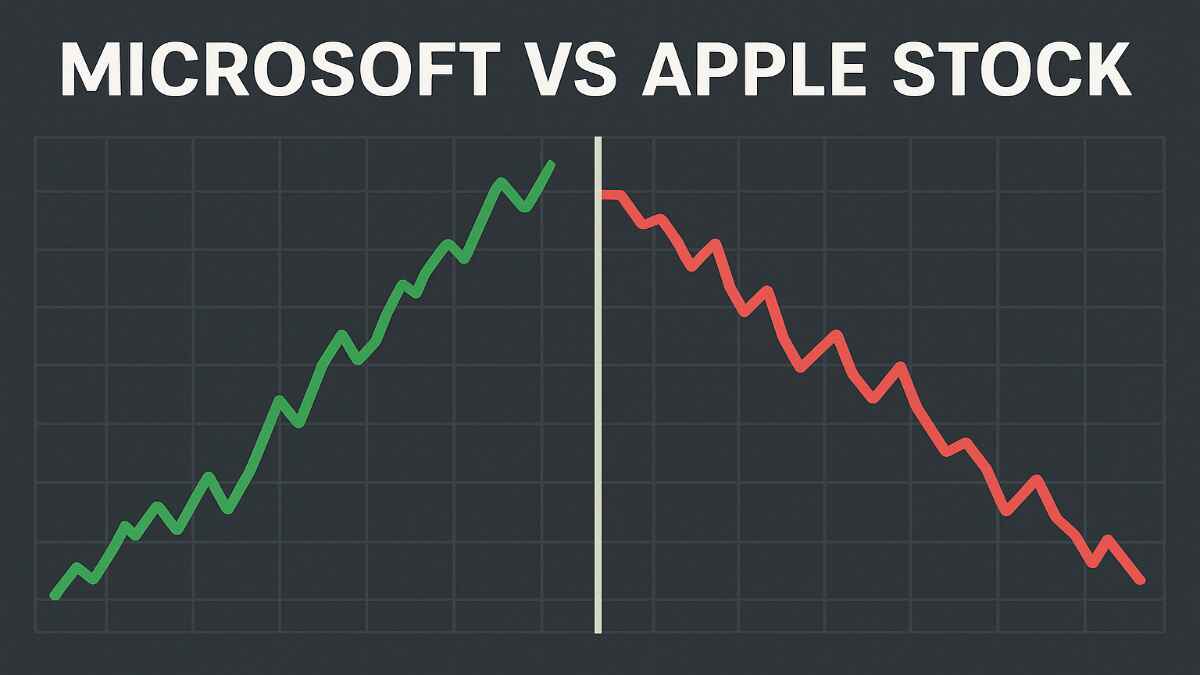
Over the last 10 years, Microsoft has outperformed Apple in stock growth. According to Nasdaq, Microsoft’s stock gained 1,148% from 2014 to March 2024, compared to Apple’s 916%. A $10,000 investment in Microsoft in 2014 would be worth over $124,800 by 2024, while the same investment in Apple would be worth $101,600. This performance highlights Microsoft’s strong growth, particularly under Nadella’s leadership.
However, Apple has shown resilience in recent years. From 2020 to 2025, Apple’s stock returned 198.81%, outpacing Microsoft’s 145.20%, according to GOBankingRates. This suggests Apple has been catching up, especially post the 2020 pandemic recovery.
| Metric | Apple (AAPL) | Microsoft (MSFT) |
|---|---|---|
| 10-Year Stock Gain (2014-2024) | 916% | 1,148% |
| 5-Year Stock Gain (2020-2025) | 198.81% | 145.20% |
| Annualized Return (10 Years) | 21.83% | 28.76% |
Revenue and Profit Growth
Apple reported $387 billion in revenue for fiscal 2024, a 2.8% increase from the previous year, driven by its services segment (up 15.3% to $96 billion). Microsoft’s revenue for fiscal 2023 was $212 billion, up 7% year-over-year, with significant contributions from its cloud segment. Over the past five years, Apple’s revenue grew by 47.32% (totaling $1,678.13 billion), while Microsoft’s grew by 68.40% (totaling $847.14 billion).
Profitability is a strength for both. Apple’s profit grew by 75.52% over five years, reaching $404.14 billion, with an operating margin of 30.4% in 2024. Microsoft’s profit grew by 111.98%, totaling $300.71 billion, with an operating margin of 43% in its cloud segment, showcasing its high profitability in growth areas.
| Metric | Apple (AAPL) | Microsoft (MSFT) |
|---|---|---|
| 5-Year Revenue Growth | 47.32% | 68.40% |
| 5-Year Profit Growth | 75.52% | 111.98% |
| Operating Margin (Latest) | 30.4% | 43% (Cloud Segment) |
Market Position and Products
Apple’s Market Position
Apple dominates the premium consumer electronics market. The iPhone holds about 20% of the global smartphone market, commanding higher prices than competitors, which boosts revenue. Apple’s ecosystem, where devices like the iPhone, iPad, and Mac integrate seamlessly, fosters customer loyalty. For example, features like iCloud syncing and AirDrop make it convenient for users to stay within Apple’s ecosystem.
The services segment is a key differentiator. With over 1 billion paid subscriptions, services like Apple Music and the App Store provide recurring revenue, reducing reliance on hardware sales. Apple’s recent ventures, such as the Vision Pro headset, signal its intent to lead in emerging markets like virtual and augmented reality (VR/AR).
Microsoft’s Market Position
Microsoft excels in enterprise software and cloud services. Office 365 is a staple for businesses worldwide, with millions of subscriptions driving steady revenue. Azure, the second-largest cloud platform after AWS, has seen robust growth, fueled by demand for cloud computing and AI solutions. Microsoft’s gaming division, bolstered by the acquisition of Activision Blizzard, positions it as a leader in the gaming industry. Additionally, LinkedIn enhances its presence in professional networking.
Microsoft’s diversified portfolio spans consumer and enterprise markets, making it less vulnerable to fluctuations in any single sector.
Growth Drivers
Apple’s Growth Drivers
- Services Segment: Apple’s services, including Apple Music, iCloud, and Apple TV+, grew by 15.3% in 2024 to $96 billion. This high-margin segment is less cyclical than hardware, providing stability.
- AI and Machine Learning: Apple’s investment in AI, particularly through Apple Intelligence, aims to enhance user experiences across devices, such as improved Siri functionality.
- VR/AR: The Vision Pro headset, priced at $3,499, targets the growing VR/AR market, projected to have a 31% CAGR through 2030.
Microsoft’s Growth Drivers
- Cloud Computing: Azure’s revenue grew by 24% in the latest quarter, driven by demand for cloud services and AI integration. Microsoft’s partnership with OpenAI has led to AI enhancements in products like Bing and Office.
- Productivity Software: Office 365 continues to see steady subscription growth, with businesses relying on tools like Word, Excel, and Teams.
- Gaming: The acquisition of Activision Blizzard strengthens Microsoft’s gaming division, with Xbox and Game Pass driving growth in a high-potential market.
Risks and Challenges
Apple’s Risks
- Dependence on iPhone: The iPhone accounts for a significant portion of Apple’s revenue. Market saturation or declining sales could impact growth.
- Geopolitical Risks: Apple’s reliance on China for manufacturing and sales (18% of 2022 revenue) exposes it to trade tensions and regulatory changes.
- Competition: Apple faces competition in hardware (e.g., Samsung) and services (e.g., Spotify), which could pressure margins.
Microsoft’s Risks
- Cloud Competition: Azure competes with AWS and Google Cloud, and price wars could reduce margins.
- Regulatory Scrutiny: Microsoft’s acquisitions, like Activision Blizzard, have drawn antitrust attention, potentially limiting future deals.
- Market Saturation: The enterprise software market may be nearing saturation, which could slow growth in Office 365.
Valuation
As of August 2025, Apple’s stock trades at a price-to-earnings (P/E) ratio of approximately 30, while Microsoft’s is around 36. However, Microsoft’s forward P/E ratio, which accounts for expected earnings growth, is slightly lower relative to its growth prospects. The price-to-earnings-to-growth (PEG) ratio, which factors in growth, shows Microsoft at 2.2 and Apple at 2.7, suggesting Microsoft may be undervalued relative to its growth potential.
| Metric | Apple (AAPL) | Microsoft (MSFT) |
|---|---|---|
| P/E Ratio (Trailing) | 30 | 36 |
| Forward P/E Ratio | 28 | 35 |
| PEG Ratio | 2.7 | 2.2 |
Analyst Opinions
Analysts often favor Microsoft for its growth potential in AI and cloud computing. A January 2024 Reuters survey found that all 13 investors consulted expected Microsoft to surpass Apple in market value within five years. Morningstar’s 2023 analysis suggested Microsoft’s stock was 17% undervalued, while Apple’s was fairly valued. However, Apple’s strong fundamentals and cash reserves make it a reliable choice for conservative investors.
Long-Term Investment Thesis
When considering Microsoft vs Apple Stock: Which Is Better for Long-Term Investment?, both companies offer compelling cases:
- Microsoft: Its leadership in cloud computing, early AI adoption, and diversified portfolio make it a strong candidate for growth-oriented investors. Azure’s consistent growth and AI innovations, such as Copilot Pro, position Microsoft to capitalize on emerging trends.
- Apple: Apple’s innovative products, loyal customer base, and growing services segment provide stability. Its ventures into AI and VR/AR suggest potential for new revenue streams, while its cash reserves (over $100 billion) offer a buffer against economic downturns.
The choice depends on your investment goals. Microsoft may appeal to those seeking higher growth, while Apple suits investors prioritizing stability. Holding both could provide diversification, balancing growth and reliability.
India-Specific Considerations
For Indian investors, both companies have a significant presence. Apple has expanded its manufacturing in India, reducing reliance on China, which could mitigate geopolitical risks. Microsoft’s Azure data centers in India cater to local businesses, and its software is widely used in Indian enterprises. Both stocks are accessible through international brokers or mutual funds/ETFs listed on Indian exchanges, making them viable options for long-term portfolios.
FAQs
Which stock has higher growth potential?
Analysts suggest Microsoft has higher growth potential due to its leadership in cloud computing and AI, with a projected 16.3% annual growth rate compared to Apple’s 11%.
Which is safer for long-term investment?
Both are considered safe, but Apple’s strong cash reserves and established market position may make it slightly safer for conservative investors.
Should I invest in both?
Holding both Microsoft and Apple can diversify your portfolio, as they operate in different tech segments (enterprise software vs. consumer electronics).
What are the key risks for each company?
Apple: Dependence on iPhone sales and geopolitical risks in China.
Microsoft: Intense competition in cloud services and regulatory scrutiny.
How do their valuations compare?
Apple’s lower P/E ratio (30 vs. 36) suggests it may be better value, but Microsoft’s lower PEG ratio indicates it’s undervalued relative to growth.
Conclusion
In the debate of Microsoft vs Apple Stock: Which Is Better for Long-Term Investment?, both companies shine as exceptional choices. Microsoft’s growth in cloud and AI makes it attractive for those seeking higher returns, while Apple’s stability and innovation ensure it remains a solid pick. For Indian investors, both offer accessibility and long-term potential. Your decision should align with your risk tolerance and investment horizon. Whether you choose Microsoft, Apple, or both, these tech giants are likely to remain leaders for years to come.
Disclaimer: Moneyjack.in provides general financial information for educational purposes only. We are not financial advisors. Content is not personalized advice. Consult a qualified professional before making financial decisions. We are not liable for any losses or damages arising from the use of our content. Always conduct your own research.