Introduction
Bonds are a vital part of the financial landscape, offering a way for governments and companies to raise funds while providing investors with a relatively safe avenue to earn steady income. In India, bonds are gaining popularity among retail investors, thanks to their stability compared to volatile stock markets. However, navigating the bond market can feel daunting due to technical terms like Face Value, Coupon Rate, and Maturity. These concepts are the building blocks of bond investing, and understanding them is crucial for making informed decisions.
This article explains Face Value, Coupon Rate, and Maturity in simple English, tailored for Indian investors. We’ll break down each term with clear definitions, practical examples, and insights into their role in the bond market. We’ll also explore the types of bonds available in India, how the bond market operates, and tips for investing wisely. By the end, you’ll have a thorough understanding of these terms and feel confident navigating the bond market.Understanding Face Value Coupon Rate and Maturity
Let’s dive into the world of bonds and unravel these essential concepts!
Table of Contents
What is a Bond?
Before we explore Face Value, Coupon Rate, and Maturity, let’s clarify what a bond is. A bond is essentially a loan you give to an issuer—such as the Indian government, a public sector undertaking (PSU), or a private company. In return, the issuer promises to:
- Pay you regular interest (called coupon payments) during the bond’s life.
- Return the principal amount (face value) when the bond matures.
Bonds are considered safer than stocks because they offer predictable income and a fixed repayment schedule. However, they come with risks like interest rate changes or issuer default, which we’ll discuss later. Understanding the key terms—Face Value, Coupon Rate, and Maturity—is the first step to mastering bond investments.
What is Face Value?
Definition
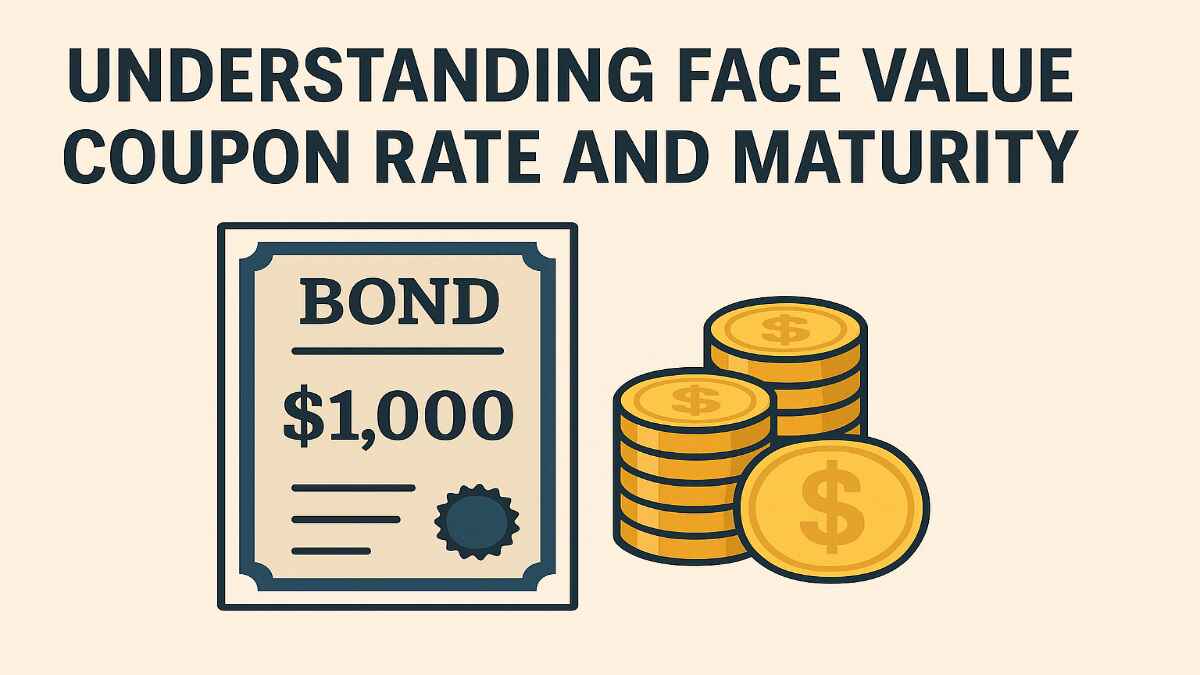
Face Value, also known as par value or nominal value, is the amount the bond issuer promises to repay the bondholder when the bond reaches its maturity date. It’s the principal amount of the bond and is typically printed on the bond certificate.
- Key Point: The face value is not the price you pay to buy the bond, which can vary in the secondary market. It’s the amount you’ll receive at maturity, assuming the issuer doesn’t default.
Why Face Value Matters
- Basis for Interest Payments: The face value is used to calculate the bond’s coupon payments. For example, a bond with a ₹10,000 face value and a 5% coupon rate pays ₹500 annually.
- Repayment Guarantee: At maturity, you receive the face value, providing certainty about the principal repayment (assuming no default).
- Market Price Reference: Bonds trade at a discount (below face value) or premium (above face value) based on market conditions, but the face value remains constant.
Example
Suppose you buy a bond issued by the Indian government with a face value of ₹10,000. At maturity, you’ll receive ₹10,000, regardless of whether you bought the bond for ₹9,000 (a discount) or ₹11,000 (a premium). The face value also determines your interest payments during the bond’s life.
Face Value in Context
- Stocks vs. Bonds: In stocks, face value is a nominal amount (e.g., ₹10 per share) and doesn’t reflect market value. In bonds, face value is critical as it directly impacts returns.
- Inflation-Linked Bonds: Some bonds, like India’s Inflation-Indexed Bonds, adjust the face value based on inflation, protecting investors from rising prices.
| Aspect | Description |
|---|---|
| Definition | The amount repaid at maturity. |
| Role | Basis for coupon payments and principal repayment. |
| Example | ₹10,000 bond returns ₹10,000 at maturity. |
| Stability | Fixed, unless the bond is inflation-linked. |
Key Takeaway: Face value is the fixed amount you’ll receive at maturity and the basis for calculating interest payments. It’s a cornerstone of bond valuation.
What is Coupon Rate?

Definition
The Coupon Rate is the annual interest rate the bond issuer pays to the bondholder, based on the bond’s face value. It’s expressed as a percentage and is fixed when the bond is issued.
- Key Point: The coupon rate determines the annual interest (coupon payment) you receive. For example, a ₹10,000 bond with a 5% coupon rate pays ₹500 per year.
How Coupon Rate is Calculated
The formula for the annual coupon payment is:
[
\text{Annual Coupon Payment} = \text{Face Value} \times \text{Coupon Rate}
]
For example:
- Face Value = ₹10,000
- Coupon Rate = 6%
- Annual Coupon Payment = ₹10,000 × 0.06 = ₹600
Most bonds pay coupons semi-annually, so you’d receive ₹300 every six months in this case.
Why Coupon Rate Matters
- Predictable Income: The coupon rate provides a steady income stream, making bonds attractive for conservative investors.
- Attractiveness: Higher coupon rates make bonds more appealing, especially when market interest rates are low.
- Fixed Nature: For most bonds, the coupon rate doesn’t change, offering certainty compared to variable stock dividends.
Example
Imagine you invest in a corporate bond with a face value of ₹5,000 and a coupon rate of 7%. You’ll receive ₹350 annually (7% of ₹5,000), typically paid as ₹175 every six months.
Types of Coupon Rates
- Fixed Coupon Rate: Most bonds have a fixed rate, like 7.15% for an RBI bond.
- Floating Coupon Rate: Adjusts periodically based on a benchmark like the Mumbai Interbank Offered Rate (MIBOR), reducing interest rate risk.
- Zero-Coupon Bonds: These bonds have a 0% coupon rate, paying no interest but issued at a discount.
| Aspect | Description |
|---|---|
| Definition | Annual interest rate paid on face value. |
| Calculation | Face Value × Coupon Rate = Annual Payment. |
| Example | ₹5,000 bond with 7% rate pays ₹350/year. |
| Types | Fixed, floating, or zero-coupon. |
Key Takeaway: The coupon rate determines your bond income and is fixed for most bonds, ensuring predictable returns.
What is Maturity?
Definition
Maturity is the date when the bond issuer repays the face value to the bondholder, marking the end of the bond’s life. After Ascendancy
Why Maturity Matters
- Principal Repayment: At maturity, you receive the face value, completing the bond’s lifecycle.
- Risk and Return: Longer maturities carry higher risks (e.g., interest rate fluctuations) but often offer higher coupon rates.
- Investment Horizon: Maturity determines how long your money is tied up, affecting liquidity and risk.
Types of Maturity
- Short-Term: Less than 5 years (e.g., Treasury Bills).
- Medium-Term: 5-10 years.
- Long-Term: Over 10 years (e.g., long-dated G-Secs).
Example
A 10-year bond with a ₹10,000 face value and 6% coupon rate pays ₹600 annually (or ₹300 semi-annually) for 10 years. At the end of year 10, you receive ₹10,000.
Maturity and Bond Prices

- Interest Rate Sensitivity: Long-term bonds are more affected by interest rate changes, causing larger price swings.
- Yield Curve: Longer maturities typically offer higher yields to compensate for risk.
| Aspect | Description |
|---|---|
| Definition | Date when face value is repaid. |
| Types | Short-term (<5 years), medium-term (5-10 years), long-term (>10 years). |
| Example | 10-year bond repays ₹10,000 at maturity. |
| Impact | Affects risk, return, and liquidity. |
Key Takeaway: Maturity defines the bond’s lifespan and influences its risk and return profile.
Yield to Maturity (YTM): A Key Concept
Definition
Yield to Maturity (YTM) is the total return expected if you hold a bond until maturity. It accounts for:
- Current market price
- Face value
- Coupon rate
- Time to maturity
YTM differs from the coupon rate because it reflects the bond’s market price, which may be above or below face value.
Example
A bond with a ₹10,000 face value, 5% coupon rate, and 5 years to maturity, trading at ₹9,000, has a YTM higher than 5% because you gain from the price appreciation to ₹10,000 at maturity.
| Aspect | Coupon Rate | YTM |
|---|---|---|
| Definition | Fixed interest rate on face value. | Total return if held to maturity. |
| Stability | Fixed at issuance. | Varies with market price. |
| Example | 5% on ₹10,000 = ₹500/year. | Higher if bought at ₹9,000. |
Relationship Between Face Value, Coupon Rate, and Maturity
- Face Value and Coupon Rate: The coupon rate is applied to the face value to calculate interest payments.
- Maturity and Risk: Longer maturities increase exposure to interest rate and inflation risks.
- Market Dynamics: Rising market interest rates lower bond prices, and vice versa.
Types of Bonds in India
- Government Bonds: Low-risk, issued by RBI (e.g., T-Bills, G-Secs).
- Corporate Bonds: Higher yield, higher risk (e.g., PSU bonds).
- Zero-Coupon Bonds: No periodic interest, issued at a discount.
- Floating-Rate Bonds: Adjustable rates based on benchmarks like MIBOR.
- Convertible Bonds: Can convert into company shares.
The Indian Bond Market
India’s bond market is robust, with:
- Government Securities: Regulated by RBI, highly liquid.
- Corporate Debt: Regulated by SEBI, growing in popularity.
Recent trends include digital platforms and FII participation.
Investing in Bonds
- How to Buy: Primary market (direct issuance) or secondary market (NSE/BSE).
- Risks: Interest rate, credit, liquidity, and inflation risks.
- Benefits: Steady income, safety, diversification.
FAQs
What’s the difference between face value and market value?
Face value is fixed; market value fluctuates with interest rates.
How is the coupon rate set?
Based on market interest rates at issuance.
What happens at maturity?
The issuer repays the face value, and coupons stop.
Can coupon rates change?
Fixed for most bonds; floating-rate bonds adjust periodically.
Why do bond prices fall when interest rates rise?
New bonds offer higher yields, reducing demand for existing bonds.
What are zero-coupon bonds?
Issued at a discount, no periodic interest, mature at face value.
Are government bonds risk-free?
Low risk, but not immune to inflation or interest rate risks.
How to invest in bonds in India?
Through exchanges, mutual funds, or banks.
How is bond income taxed in India?
Interest is taxable per your slab; some bonds are tax-free.
How to calculate YTM?
Use financial calculators or software to estimate total return.
Conclusion
Face Value, Coupon Rate, and Maturity are the pillars of bond investing. They determine your returns, risks, and investment horizon. In India, bonds offer diverse opportunities, from safe government securities to higher-yield corporate bonds. By understanding these terms, you can make informed investment choices and build a balanced portfolio. Always assess risks and consult a financial advisor for personalized guidance.
Disclaimer: Moneyjack.in provides general financial information for educational purposes only. We are not financial advisors. Content is not personalized advice. Consult a qualified professional before making financial decisions. We are not liable for any losses or damages arising from the use of our content. Always conduct your own research.