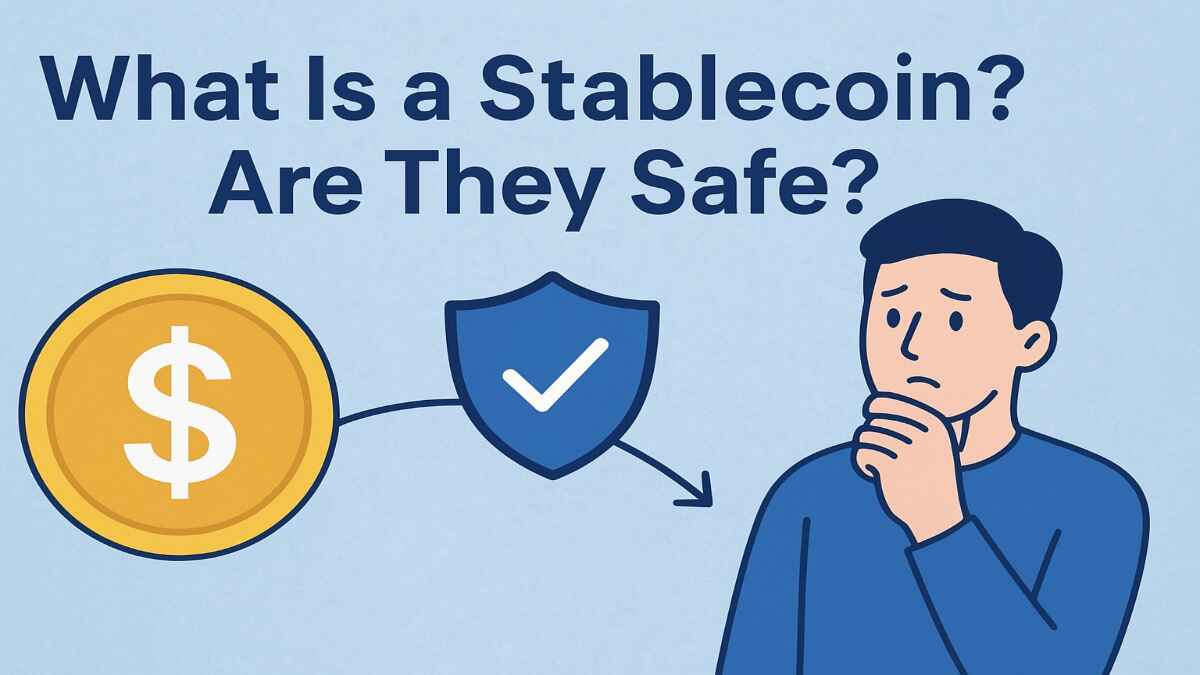
Hey there! If you’re dipping your toes into the world of cryptocurrencies, you’ve probably heard the buzz about stablecoins. They’re like the steady ship in the stormy sea of crypto volatility. But what is a stablecoin? Are they safe? Especially if you’re in India, where the RBI keeps a watchful eye on all things digital finance, these questions hit close to home. In this article, I’ll break it all down in simple English, with a friendly chat-like vibe, just like explaining it to a friend over chai. We’ll explore what stablecoins are, how they work, their pros and cons, and whether they’re a smart bet for your wallet in 2025.
Table of Contents
What Is a Stablecoin?
So, what is a stablecoin? At its core, a stablecoin is a type of cryptocurrency designed to maintain a stable value, unlike wild rides like Bitcoin or Ethereum that can swing dramatically in price. Imagine Bitcoin as a rollercoaster—thrilling but scary. A stablecoin is more like a calm bicycle ride; it aims to stay steady, usually pegged to something reliable like the US dollar, gold, or even a basket of assets.
Stablecoins first popped up around 2014, with Tether (USDT) leading the pack. The idea was simple: create digital money that combines the best of crypto (fast, borderless transactions) with the reliability of traditional cash. In a nutshell, they’re digital tokens on a blockchain that promise price stability, making them useful for everyday stuff like sending money or trading without the fear of losing your shirt overnight.
But why do they matter? In volatile markets, stablecoins act as a safe harbor. For instance, if you’re trading crypto and see a dip coming, you can quickly swap to a stablecoin to preserve your value. They’re not just for traders, though—businesses use them for payments, and in places like India, where remittances are huge (we receive over $100 billion annually!), stablecoins could slash fees and speed up transfers. What is a stablecoin in practical terms? It’s your digital wallet’s safety net, blending innovation with peace of mind.
Stablecoins come in different flavors, each with its own way of staying “stable.” We’ll get into types next, but remember: while they aim for stability, not all are created equal. Some have proven rock-solid, others… not so much. So, what is a stablecoin? It’s crypto’s answer to steady money—but as we’ll see, safety isn’t always guaranteed.
Types of Stablecoins: Which One Fits Your Needs?
Now that we’ve covered the basics—what is a stablecoin?—let’s talk varieties. Stablecoins aren’t one-size-fits-all; they come in four main types, each with unique backing and risks. Understanding these helps answer: are they safe? Especially in India, where regulations are evolving, picking the right type matters.
First up: fiat-collateralized stablecoins. These are backed by real-world currencies like the US dollar, held in reserves by trusted custodians. Think of it as digital cash in a bank vault. Popular ones include Tether (USDT) and USD Coin (USDC). They’re simple and stable, but you must trust the issuer’s audits. In India, where the RBI is cautious about foreign-backed assets, these could face scrutiny, but they’re great for remittances—imagine sending money home from the Gulf without hefty fees.
Next: crypto-collateralized stablecoins, like DAI from MakerDAO. These use other cryptocurrencies as backing, often over-collateralized (e.g., $150 in Ethereum for $100 in DAI) to handle volatility. They’re decentralized—no single company controls them—which appeals to privacy-focused users. But if crypto prices crash, liquidation risks spike. For Indians exploring DeFi (decentralized finance), DAI offers independence from banks, but it’s riskier in volatile markets.
Then there are commodity-backed stablecoins, pegged to assets like gold (e.g., Tether Gold or Pax Gold). These provide a hedge against inflation—perfect if you’re worried about rupee fluctuations. They’re tangible and diversified, but storage and audits add complexity. In gold-loving India, these could boom for digital savings, especially with our cultural affinity for precious metals.
Finally: algorithmic stablecoins, like the infamous TerraUSD (before its crash). These use smart contracts to adjust supply based on demand—no reserves needed. They’re innovative and efficient but prone to “death spirals” if confidence drops. Terra’s 2022 collapse wiped out billions, showing why they’re high-risk. In India, where the RBI prioritizes stability, these might stay on the sidelines until proven safe.
So, what is a stablecoin’s type matter for safety? Fiat and commodity-backed ones feel more secure for beginners, while crypto-collateralized suit DeFi enthusiasts. Algorithmic? Proceed with caution. In India, as regulations tighten (more on that later), fiat-backed might win for compliance. Choose based on your risk tolerance—stablecoins can be safe, but the type makes all the difference.
How Do Stablecoins Work? The Mechanics Behind the Stability

Curious about the nuts and bolts? What is a stablecoin without understanding its inner workings? Stablecoins maintain their peg through clever mechanisms, blending tech and economics. Let’s unpack this step by step, with an Indian twist—think of it as a reliable auto-rickshaw in Mumbai traffic: steady despite the chaos.
At heart, stablecoins use collateral or algorithms to stay pegged. For fiat-backed like USDT, each token equals $1 in reserves. Issuers hold cash or equivalents in banks, audited regularly. When you buy USDT, they mint tokens; sell, and they burn them, balancing supply. It’s like a digital fixed deposit—stable, but trust the bank (issuer).
Crypto-backed like DAI work differently: over-collateralize with assets like Ethereum. Lock $150 ETH to mint $100 DAI. If ETH drops, smart contracts liquidate collateral to maintain the peg. It’s decentralized, no middleman—perfect for India’s growing DeFi crowd, but volatility can trigger sales, like a margin call on your stocks.
Commodity-backed? Peg to gold or oil reserves. Buy a token, own a fraction of physical assets in vaults. Audits ensure backing. In India, where gold is king (we buy 800+ tons yearly!), these appeal for digital jewelry savings without storage hassles.
Algorithmic ones? No collateral—just code. Supply expands/contracts based on demand. TerraUSD tried this, but failed spectacularly when panic hit. It’s like an AI-managed economy: innovative, but crashes hard if faith wavers.
Arbitrage keeps them stable: if a coin dips below $1, buy cheap and redeem for $1 profit, pushing price up. Vice versa for over-peg. In India, with $110B remittances (2023), stablecoins could cut 7% fees via fast, pegged transfers. But RBI’s caution on “private” coins means CBDC (digital rupee) pilots are prioritized.
What is a stablecoin’s secret sauce? Tech like smart contracts on Ethereum automate everything, ensuring transparency. But risks lurk: poor reserves or code bugs can de-peg. Are they safe? Mostly yes, if backed well—but always DYOR (do your own research). In 2025, with clearer rules, they’ll likely shine brighter for Indians seeking crypto stability.
Popular Stablecoins in 2025: USDT, USDC, DAI, and More
Building on how they work, let’s spotlight today’s stars. What is a stablecoin without real examples? In 2025, USDT, USDC, and DAI dominate, each with billions in circulation. They’re not just tokens—they’re reshaping finance, especially in India where crypto users hit 100 million+.
USDT (Tether): The kingpin, with $112B market cap. Pegged to USD, backed by reserves (cash, bonds). It’s everywhere—exchanges, remittances. In India, it’s a fave for dodging rupee volatility; send money from Dubai home instantly, fees under 1%. But past transparency issues (fines in 2021) make some wary. Safe? Mostly, but centralized.
USDC (Circle’s USD Coin): $32B cap, fully regulated, audited monthly. Backed by USD/Treasuries in US banks. It’s the “safe” choice—institutions love it for compliance. For Indians, it’s ideal for DeFi lending; earn 5-10% yields without wild swings. Post-2023 de-peg scare (Silicon Valley Bank tie), it’s rebounded stronger. Are they safe? USDC’s track record says yes.
DAI (MakerDAO): $5B cap, decentralized, crypto-backed (ETH, etc.). No single controller—community governs via votes. Over-collateralized (150%+), it’s DeFi’s darling. In India, tech-savvy users use it for borderless loans; borrow against ETH without selling. But 2022 volatility showed risks—if collateral crashes, liquidations hurt. Safe for pros, riskier for newbies.
Others rising: PYUSD (PayPal USD, $500M cap) for payments; FDUSD (First Digital, $2B) for Asia focus; RLUSD (Ripple, $500M) for cross-border. In India, with RBI’s CBDC push, these compete but shine in remittances ($100B+ yearly market).
What is a stablecoin’s appeal in 2025? Liquidity—USDT trades $50B daily! For Indians, they’re a hedge against inflation (rupee down 5% yearly). But are they safe? USDT/USDC yes for most; DAI for DeFi pros. Pick based on needs: trading (USDT), safety (USDC), decentralization (DAI). As India eyes regulation, these could boom—or face curbs. Stay tuned!
Benefits of Stablecoins: Why They’re Gaining Popularity in India
Now that we’ve met the players, let’s talk perks. What is a stablecoin’s real draw? Stability in chaos! In India, with crypto users surging (15% of adults own some!), they’re a lifeline. Low volatility means no sleepless nights over price drops—peg to USD, hold value amid rupee wobbles (down 4% in 2024).
Fast, cheap transactions: Send $1,000 to family abroad? Traditional banks charge 5-7%, take days. Stablecoins? Under 1%, minutes. India’s $110B remittance market saves billions! Businesses love it—pay global freelancers instantly, no forex hassle.
DeFi access: Earn 5-15% yields on USDC/DAI via lending platforms. Better than bank FDs (6-7%)! For unbanked Indians (190M adults), stablecoins mean financial inclusion—no ID needed for basics.
Hedge inflation: Rupee at 7% inflation? Hold USDC, preserve purchasing power. Traders use them as “parking spots” between volatile bets.
In India, post-2022 tax (30% on gains, 1% TDS), stablecoins minimize tax hits—no “gains” if peg holds. What is a stablecoin’s edge? Borderless—export goods, get paid in USDT, convert to rupees seamlessly.
But are they safe? Benefits shine when regulated. RBI’s caution (no ban, but VDAs taxed) means growth, but watch for rules. For everyday Indians, stablecoins cut costs, boost speed—popularity soaring!
Risks of Stablecoins: Lessons from Past Collapses and Safety Concerns
Benefits sound great, but let’s flip the coin—what is a stablecoin’s dark side? Are they safe? History screams “not always.” TerraUSD’s 2022 crash wiped $40B—algorithm failed, peg broke, “death spiral” ensued. Lesson? Algorithmic types are risky; no real backing means panic kills.
De-peg risk: Even fiat-backed like USDT dipped to $0.95 in 2022 amid fear. Reserves? Tether’s opacity led to $41M fine. In India, RBI warns: foreign-backed stablecoins could undermine rupee, enable laundering.
Centralization woes: USDC’s 2023 mini-depeg (SVB exposure) showed bank ties hurt. Crypto-backed DAI? Collateral crashes trigger liquidations—painful in bear markets.
Regulatory haze: India’s 30% tax + 1% TDS hurts, but no ban. Yet, FIU-IND registration for exchanges means scrutiny. Global: EU’s MiCA bans algorithmic—India might follow.
Illicit use: Anonymity aids scams; $14B laundered via stablecoins in 2023. In India, hacks like WazirX ($230M loss) highlight custody risks.
Market contagion: Terra crash tanked Bitcoin 50%. Systemic? If USDT (70% market) fails, crypto Armageddon.
Are they safe in 2025? Backed ones yes, with audits. But DYOR—check reserves, team. For Indians, CBDC (e-rupee pilots) safer alternative. Stablecoins? Powerful, but handle with care—like a pressure cooker, great if used right!
Are Stablecoins Safe? Evaluating Risks and Rewards in 2025

So, circling back: what is a stablecoin, and are they safe? In 2025, they’re safer than ever—but not bulletproof. Rewards? Stability (peg holds 99% time), speed (instant transfers), yields (5-20% in DeFi). Risks? De-pegs, hacks, regs.
Fiat-backed like USDC: Safest, audited reserves—post-GENIUS Act (US law mandates 1:1 backing), transparency up. But centralized—issuers can freeze (USDC did in 2023 tornado cash probe).
Crypto-backed DAI: Decentralized safety—no single failure point. But volatility: 2022 crash liquidated $1B+. Algorithmic? Avoid—Terra scarred the space.
In India, RBI’s stance: “Risky for sovereignty,” no backing for private stablecoins. Yet, 100M+ users trade them. Safe bet? Use regulated exchanges (FIU-IND registered), diversify (mix USDT/USDC), watch news (e.g., 2024 MiCA EU ban on unbacked).
2025 trends: Yield-bearing (earn while holding), multi-chain (faster, cheaper). Rewards outweigh risks for savvy users—remittances save 70% fees. But are they safe? 8/10—better than volatile crypto, riskier than FDs. Bottom line: Educate, diversify. Stablecoins aren’t “set it and forget it”—monitor like any investment. In India’s fintech boom, they’re tools, not treasures.
Stablecoins in India: Regulations, RBI Stance, and Local Adoption
What is a stablecoin in India’s context? Same as global—steady crypto—but RBI views them warily. No outright ban, but classified as VDAs (virtual digital assets) under IT Act: 30% tax on gains, 1% TDS on trades. Safe? RBI says “systemic risks”—could undermine rupee, enable laundering.
RBI stance: Prefers CBDC (e-rupee, piloted 2022, 1M+ users by 2024). Governor: “Private stablecoins threaten sovereignty.” Yet, no prohibition; exchanges like WazirX offer USDT/USDC. Adoption? Huge—India tops global crypto users (100M+), stablecoins key for remittances ($110B yearly, 7% fees traditional vs. 1% crypto).
Regulations: FIU-IND mandates exchange registration (28 by 2024), AML/KYC compliance. IMF-FSB paper (2023) urges India to regulate, not ban. 2025 outlook: Discussion paper expected—could allow rupee-backed stablecoins for trade.
Local use: Freelancers earn USDC, avoid forex; traders hedge with DAI. Safe? Exchanges compliant, but off-ramp risks (bank freezes). Are they safe in India? 7/10—tax hurts, but growing ecosystem. Watch RBI—CBDC integration could mainstream them. For now, stablecoins fill gaps traditional finance can’t.
The Future of Stablecoins: Trends and Predictions for 2025 and Beyond
What is a stablecoin’s tomorrow? In 2025, they’re evolving—$200B+ market, up 20% from 2024. Trends: Yield-bearing (earn 5-10% holding USDC via protocols), multi-currency (EURC, GBP-pegged rise for non-USD markets).
India angle: RBI’s e-rupee expands (10M users projected), but private stablecoins grow for remittances—$150B market by 2025, stablecoins capture 10%. Safe? GENIUS Act (US, 2024) mandates audits; India may follow, boosting trust.
Predictions: DeFi integration deepens—$1T locked; cross-border payments boom (Visa/Mastercard accept USDT). Risks? Quantum threats—post-quantum crypto by 2027. Are they safe long-term? Yes, with regs—hybrid models (fiat+algo) emerge.
In India, fintechs like PhonePe integrate—stablecoins for micro-loans. Global: CBDC-stablecoin hybrids. Future? Ubiquitous as cash, but digital. What is a stablecoin in 2030? Everyday money, borderless and stable.
FAQ:
What is a stablecoin?
A cryptocurrency designed to maintain steady value, pegged to assets like USD.
Are stablecoins safe for Indians?
Mostly yes, but RBI cautions; use regulated exchanges, diversify.
What’s the best stablecoin for remittances?
USDT—low fees, fast; saves 70% vs. banks.
How do taxes work on stablecoins in India?
30% on gains, 1% TDS; no tax if peg holds (no “gain”).
Can stablecoins replace the rupee?
No—RBI says they threaten sovereignty; e-rupee is official.
What’s next for stablecoins in 2025?
Yield-bearing, multi-chain; India may regulate rupee-backed ones.
Disclaimer: Moneyjack.in provides general financial information for educational purposes only. We are not financial advisors. Content is not personalized advice. Consult a qualified professional before making financial decisions. We are not liable for any losses or damages arising from the use of our content. Always conduct your own research.